Unknown's avatar

About adivaani

A platform for adivasi expression based in Kolkata.

Our Indiegogo campaign: The adivaani time machine needs your help

Dear All,

So the adivaani ideator is in trouble.  The idea behind making books for and by Adivasis was to challenge every misconstrued notion about us. Also, and more importantly, adivaani is a response to the indigenous peoples of India’s identity being threatened, ignored, misrepresented and supressed. The problem is we can’t do it alone.

We’re 3 books old now and we’ve got a lot of attention, expectations and responsibility. Along with the accolades, came requests and suggestions for our books. ‘We love your books.’ ‘We haven’t seen this quality in Santali publishing before.’ ‘Your books are priced well.’ ‘Your books are telling our story.’ ‘Can you do our creation stories too?’ ‘Can we have the Santal Creation story in Hindi?’

I’m elated with the response and thrilled with the promise of what we can do. With the first sale and surge in book sales and the first bookstores willing to source our books in Ranchi and Kolkata, the excitement just grew.

The second book of the Santal Creation Stories for children is ready for print and the third is in the pipeline, the Santali folklore book is also ready, and Gladson is finishing his second book in English. That is certainly to be celebrated. However they are all on hold now–waiting to be printed and I can’t actually take them to the press. What a pity!

And with that come sleepless nights, worries and utter helplessness. It’s not easy to build a time machine, which does more than time travel. It actually documents and tools adivasi history. Not only will we go back in time to rescue what we forgot to bring into the present, we’ll ensure everything preserved move with every generation of adivasis into the future.

So the idea churner is churning out idea after idea after idea–quite exhilarating but I’m beginning to think, have I bitten off more than I can chew? I’m just a regular working-class Adivasi girl, trying to make ends meet, with a treasure of an idea.

Sometimes I think of giving up. But the enormity of what adivaani and its time machine could do keeps the passion alive. I not only realize what we can and must do, but that it has to be done now. We are in a hurry. We refuse to be a forgotten peoples.

I really want our books to go from being on hold to being available for your reading pleasure and our time machine to take off. So I really am in trouble and want you to bail us out.

Will you?

Please donate at:

A time machine for Adivasis

A time machine for Adivasis

Indiegogo (Click)

It’s a simple 3 step process. You can use your debit, credit or paypal account to donate from wherever you are. It doesn’t matter how much you contribute, we will be grateful for it.

Please spread the word of our online fundraising campaign by forwarding this message, liking our campaign on Facebook and Tweeting about it.

We need to get 5,000 USD in 60 days … we only have 30 days before the campaign closes and we’re only at 25 USD. That’s disheartening! The countdown has begun.

In hope,

Ruby Hembrom

Where to buy our books

Order our books online at:

http://www.earthcarebooks.com/

https://www.ilandlo.com/

http://www.amazon.in/

https://www.flipkart.com/

Or walk into these very special bookstores in Kolkata, Ranchi, Delhi and Odisha and find us there.

················

Kolkata: West Bengal

Earthcare Books
10 Middleton Street
Kolkata-700071
West Bengal

Phone:  33  22296551 / 22276190
Email:   earthcarebooks@gmail.com
Website : www.earthcarebooks.com

………….

Ranchi: Jharkhand

Adivasi Concerns Trust 

B.I.R.S.A. Mines Monitoring Centre

Abilasha Apartments, 11 A Purulea Road

Ranchi 834001

················

New Delhi

People Tree

8, Regal Building

Parliament Street                                                                                                                                                                                                                           New Delhi-01.

Phone:011 23744877

……………

Odisha

Walking BookFairs

Khandagiri, Housing Board Colony, Phase I, HIG -34.

AMRI Hospital Road.

Bhubaneswar

Odisha 751030

We’re still working on some more deals for you to have easy access to our books… so stay around, we’ll announce more places soon.

Press coverage: Amitav Ghosh ‘Tweets’ adivaani release

Gladson at  the New Delhi World Book Fair

Writer Amitav Ghosh had posted a tweet on Gladson Dungdung’s new book.

Press coverage: ‘It’s time Adivasis wrote, spoke about their anguish’

Gladson Dungdung

In 1980, one-year-old Gladson Dungdung and his family were displaced from their agricultural land for the construction of Kelaghat dam in Jharkhand and pushed into the forests of Simdega, where Dungdung’s father was arrested on allegations of felling trees. Ten years later, Dungdung’s parents, during another land struggle, were murdered.

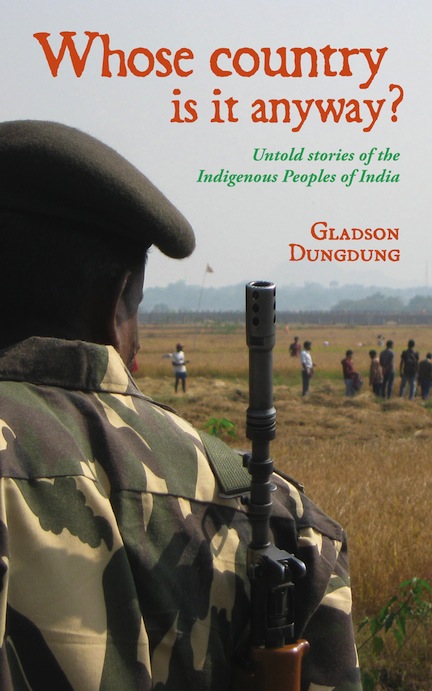
In his book, ‘Whose country is it anyway?’ Dungdung writes, “The Kelaghat dam was constructed with the aim of irrigating land in Simdega block. Three villages, Bernibera, Bara Barpani, and Budhratoli, were submerged and it affected 3,500 people. Currently, the water reaches only one village — Meromdega.”

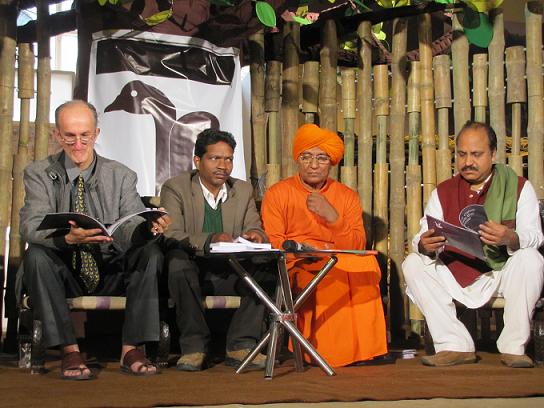
The book published by Adivaani and launched on Thursday at the Delhi World Book Fair by Himanshu Kumar, Swami Agnivesh and Felix Padel, is Gladson Dungdung’s attempt to tell the story of his people and their struggle.

Read the entire piece by the Indian Express

Press coverage: Tribal ministers have become slaves of their seniors

1GSW

Ministers who need to raise issues of tribals in Parliament “become slaves” of senior ministers and forget about the “rights of Adivasis”, Swami Agnivesh on Thursday claimed.

“All those who are elected as ministers to represent tribals in the Parliament to fight for their rights and atrocities committed upon them, themselves become slaves of big ministers and forget about the rights of Adivasis,” he said after releasing a book titled ‘Whose Country is it Anyway?’ written by Gladson Dungdung, a human rights activist of Jharkhand, at the World Book Fair here.

Read the entire wire by PTI

A review by Felix Padel On Gladson’s new book

Felix Padel

The book’s documentation of the many forms of violence and prejudice ranged against Adivasis fills a vital gap in literature. The detail is often sickening and will make any sane person extremely angry. It is shown how Adivasis are being displaced by dams, by industrial/mining projects, by continuing tricks of non-Adivasis

Read the entire review

Tehelka Interview with Gladson Dungdung

Video

Debate on adivasis, politics and Gladson’s new book

Our Author: A brief interview with Gladson Dungdung

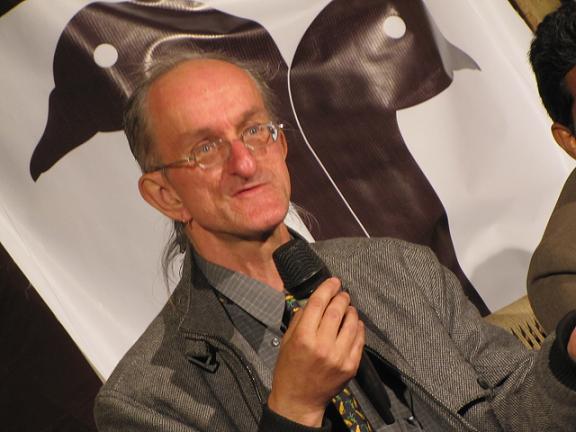
Gladson Dungdung is a noted human rights activist, writer and motivator. He is not far removed from the realities of exploitation and struggles that he writes, talks and fights against. He too is a victim of displacement, who’s suffered since his childhood. His family’s agriculture land was submerged in a dam and his parents were assassinated in 1990 while dealing with the conflict of their land. He started his studies under a tree in the government run primary schools and also completed high school at Simdega, but was not able to get admission in college as he didn’t have Rs. 250. Finally, between working as a daily wage labourer and finding other means to sustain himself, he migrated, joined the land rights movement and also managed to complete his postgraduate in human rights.

Gladson Dundung

Gladson Dundung’s new book

He also underwent an internship in Public Advocacy from the National Centre for Advocacy Studies, Pune, where he also learnt English and did a research on the ‘Impact of forest policies on the Adivasis of Orissa’.

Though Whose country is it anyway? is his first book in English he has authored the Hindi book Ulgulan Ka Sauda, co-edited another one–Nagri Ka Nagara–and edited the Jharkhand Human Rights Report 2001-2011. He has written more than 200 articles on the issues of Indigenous People’s rights, displacement, land alienation, human rights and social change. He is pioneer in the human rights movement in Jharkhand, undertaken the fact findings of 500 cases of human rights violations. He has also trained more than 3,000 professionals on human rights including police officers, lawyers, journalists, teachers, doctors, psychiatrists, elected representatives and social activists.

He is presently working as the General Secretary of the Jharkhand Human Rights Movement and is also a member of the Assessment and Monitoring Authority in Planning Commission (Government of India).

We had this little chat with him on writing and politics, adivasis and new projects…

In your book, you thank your wife partially because she always reminds you that you have to write… why do you have to write? What’s the core function of writing in your life?

My wife is also a freelance journalist thus she not only reads my articles (Hindi) as a reader but as someone who writes. She is aware about my capacity to write, my understanding of the subject and my passion to work for and with my community. She believes that I can create impact and bring about change in the society through my writings. The writing has facilitated the exposing of discrimination, exploitation, killings, rapes, police atrocities and what not. Though writing is my passion but it has also established my name in the public domain especially because every one of my writings is based on hardcore experiences. In fact writing has changed my life.

Whose country is it anyway? is a book about abuse and resistance, but it is mostly a book depicting a historic conflict between Adivasi peoples and the upper castes and ruler classes of this country called India. Tell us, how do you envision the end of this conflict if at all?

Since, the Adivasis are the Indigenous Peoples of India therefore, they should be recognized as India’s first citizens and a special law should be enforced to that effect. The Indian State should enforce the Constitutional provisions for Adivasis, protective laws and the United Nations Declaration on the Rights of Indigenous People. If these are enforced on the ground as provisions have been made then things will definitely change.

Looking at how some groups of leftist rebels become rogues, and how the impunity of the Police and the military persists, how can one stand politically in India today? Is the Left-Right paradigm still useful as a scheme of the political scenario?

I believe that in the fight of the Left-Right the Adivasis are the losers. They have been losing their lands, forests, water, minerals and people as well (so many Adivasis are being killed in either sides of the guns and so many are behind bars). Therefore, we should resist to ending the conflict by enforcing the Indian Constitution, Laws and Policies.

If you please can write a little about your next book projects.

I have been working on two more books – one on the war for minerals and another on the how the Adivasis are being betrayed in the name of growth and development. These two books would expose the ground realities of growth, development, displacement, mining and India’s war against its own people.

Our Artist: A brief interview with Boski Jain

According to her Blogspot profile, Boski Jain is a ‘graphic designer by degree’ but she also likes ‘to illustrate too.’ Hailing from Bhopal, Boski’s career is actually more than that, and her talents go far beyond her modest declaration of craft and proficiency.

Now 24, this young artist had already published work in a collective book by Katha and has two more fully illustrated by her over the last two years (The Mistery of Blue by Tullika Books and Ek Do Dus by Eklavya.) We come from the Geese is her first of (hopefully) many works with adivaani, where she already designed our logo and was part of the process that brought us to life last year …

BJ1

All the animals you create look like wonderful baroque pieces. Instead of fur, feathers, shells or scales, you come with lines, (fabric like) patterns and dots… tell us why? Is there a way to represent not only diversity but movement too?

My inspiration and ideas come from the variety of tribal arts and crafts in India, particularly the ones present in Madhya Pradesh as I have been living here and have been exposed to these more. Fabric like and block print like patterns come from them. They are bold and the perspective of the figures is simplified, hence the style can be beautifully adopted for a story for children.

Is creating illustrations with somebody else’s script difficult for you? Do you feel constrained as an artist?

I am not a writer (not so far). In my 2 years old career as an illustrator, I have only worked on scripts written by others and I have enjoyed doing so thoroughly. Picture books are picture driven hence I enjoy a certain degree of freedom.

What did you find most challenging to illustrate in the Santal Creation Stories? Why?

For me the worst and the best part about Santal creation stories is that I had never heard them before. It was the best because I got the chance to work on something unusual and hence I could use all of my imagination to visualize how the frames would look. The best part also includes working with editors who have placed their trust in me and have given me a lot of freedom. The most challenging part was to visualize and pictorially translate presence of certain supreme beings that are ‘shapeless, formless and inexplicable’, and yet make them comprehensible for children.

These stories have been carried through from generation to generation and maybe are being published as illustrated books for the first time. Hence there was also a question constantly at the back of my head about meeting the expectations of the ones who ‘own’ these and who have been narrating them for a long time.

By the way, you worked on We come from the Geese mixing digital with drawings and tint … is there a particular method to your work or is it just an intuitive way?

The method for working really depends upon each frame. Usually each element is individually worked upon by hand and then they are arranged digitally to make a composition.

Any new project coming soon?

I’m planning to work on more books for children. Also, I’d like to work on those books which do not begin with a story but begin with a piece of art that sets the stage for the story to follow.

Cover