Gladson Dungdung is a noted human rights activist, writer and motivator. He is not far removed from the realities of exploitation and struggles that he writes, talks and fights against. He too is a victim of displacement, who’s suffered since his childhood. His family’s agriculture land was submerged in a dam and his parents were assassinated in 1990 while dealing with the conflict of their land. He started his studies under a tree in the government run primary schools and also completed high school at Simdega, but was not able to get admission in college as he didn’t have Rs. 250. Finally, between working as a daily wage labourer and finding other means to sustain himself, he migrated, joined the land rights movement and also managed to complete his postgraduate in human rights.

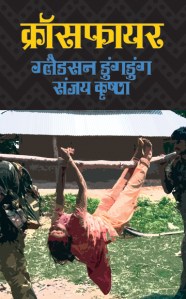
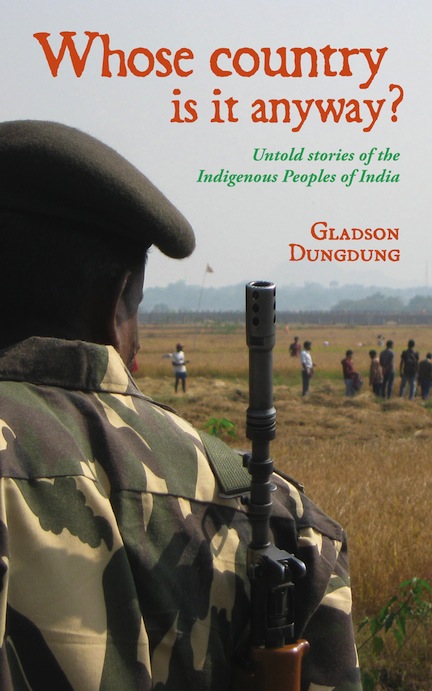
Gladson Dundung’s new book
He also underwent an internship in Public Advocacy from the National Centre for Advocacy Studies, Pune, where he also learnt English and did a research on the ‘Impact of forest policies on the Adivasis of Orissa’.
Though Whose country is it anyway? is his first book in English he has authored the Hindi book Ulgulan Ka Sauda, co-edited another one–Nagri Ka Nagara–and edited the Jharkhand Human Rights Report 2001-2011. He has written more than 200 articles on the issues of Indigenous People’s rights, displacement, land alienation, human rights and social change. He is pioneer in the human rights movement in Jharkhand, undertaken the fact findings of 500 cases of human rights violations. He has also trained more than 3,000 professionals on human rights including police officers, lawyers, journalists, teachers, doctors, psychiatrists, elected representatives and social activists.
He is presently working as the General Secretary of the Jharkhand Human Rights Movement and is also a member of the Assessment and Monitoring Authority in Planning Commission (Government of India).
We had this little chat with him on writing and politics, adivasis and new projects…
In your book, you thank your wife partially because she always reminds you that you have to write… why do you have to write? What’s the core function of writing in your life?
My wife is also a freelance journalist thus she not only reads my articles (Hindi) as a reader but as someone who writes. She is aware about my capacity to write, my understanding of the subject and my passion to work for and with my community. She believes that I can create impact and bring about change in the society through my writings. The writing has facilitated the exposing of discrimination, exploitation, killings, rapes, police atrocities and what not. Though writing is my passion but it has also established my name in the public domain especially because every one of my writings is based on hardcore experiences. In fact writing has changed my life.
Whose country is it anyway? is a book about abuse and resistance, but it is mostly a book depicting a historic conflict between Adivasi peoples and the upper castes and ruler classes of this country called India. Tell us, how do you envision the end of this conflict if at all?
Since, the Adivasis are the Indigenous Peoples of India therefore, they should be recognized as India’s first citizens and a special law should be enforced to that effect. The Indian State should enforce the Constitutional provisions for Adivasis, protective laws and the United Nations Declaration on the Rights of Indigenous People. If these are enforced on the ground as provisions have been made then things will definitely change.
Looking at how some groups of leftist rebels become rogues, and how the impunity of the Police and the military persists, how can one stand politically in India today? Is the Left-Right paradigm still useful as a scheme of the political scenario?
I believe that in the fight of the Left-Right the Adivasis are the losers. They have been losing their lands, forests, water, minerals and people as well (so many Adivasis are being killed in either sides of the guns and so many are behind bars). Therefore, we should resist to ending the conflict by enforcing the Indian Constitution, Laws and Policies.
If you please can write a little about your next book projects.
I have been working on two more books – one on the war for minerals and another on the how the Adivasis are being betrayed in the name of growth and development. These two books would expose the ground realities of growth, development, displacement, mining and India’s war against its own people.





 adivaani