adivaani

adivaani
Unknown's avatar

About adivaani

A platform for adivasi expression based in Kolkata.

Banam Raja, exploring our musical roots

adivaani has taken its archiving work to include documentary films now. Banam Raja is our first production exploring Adivasi musical traditions.
At the end of the day, Santals return to music to become whole again. They bring out their instruments into the courtyard and music, lyrics and song turn into stars in the night sky. Our musical traditions are millennial.
The banam is a stringed instrument. Banams are the lutes and the fiddles of the Santal people. They are made from locally available material–wood, vegetables and animal hide. The most common banams still made and played by Santals are the Dhodro Banam, the Reta Banam and the Phentor Banam.
This video is a tribute to our artists, who have kept our culture alive through generations.


During the process of filming we were able to record some songs by Santal musicians. Here’s a sample of their joy and pride in music—unrehearsed and performed in natural surroundings.


adivaani is going to the International Frankfurt Book Fair 2014!

German Consulate

adivaani has been invited to the most prestigious book fair in the world. We are really excited about this. Ruby will be representing us there and we hope she brings more good news from Germany in October.

In the meantime, suggestions and proposals of what to do at the International Frankfurt Book Fair 2014 are more than welcome.

Thanks to the Consul General Reiner Schmiedchen, Vice Consul Lena Schwarm Dantas and everyone at the German Consulate in Kolkata.

Adivasi PICKLE: the second edition of our writing prize is here

Adivasi Pickle

It’s that time of the year again—to come together as a community of Indigenous peoples and join the world in celebrating one day in our honor—9th August.

adivaani wants to commemorate this occasion by serving the second portion of Adivasi Pickle.

Pickle is the perfect accompaniment to spice up any spread and the one key element common to every Indian kitchen and palate.

How about some Adivasi pickle? A pickle made of indigenous ways and thinking—the perfect accompaniment to our present—with ingredients that help us understand how our ancestral ways have preserved and sustained the earth, until newer ways dismissed them as primitive and we became a resource to be extracted, exploited and ignored. Ingredients that help refurbish traditions and knowledge webs, and ensure our future.

adivaani is therefore calling Adivasis to share more about ourselves. We’ve instituted a small prize of a book, out of love, on the International Day for the World’s Indigenous Peoples, August 9th, 2014. We’re short on what we can give, but we’re long on good wishes, hope and solidarity: you write, we publish. That’s the deal!

We believe the time for us to do things our own way is now. We want this event to be a celebration of a communion of, by and for Adivasis—right from our sisters and brothers sharing and chronicling their personal narratives, to the publisher, not forgetting the jury formed of Adivasi intellectuals, scholars and artisans.

Join us, spread the word and…

Click here to participate

Ruby’s Profile in Femina, July 2014

Femina’s July 24–August 6, 2014 issue carries Ruby’s profile. Click on the image to read it.

Femina, July 2014

Unique tales of India’s tribal communities: Gulf News

gulf news

Anyone collaborating with Ruby Hembrom is sure to widen his or her mental bandwidth. For she not just thinks out-of-box but also invests her soul and spirit into the work she undertakes.

Kolkata-based Hembrom runs Adivaani, a publishing house for adivasi (tribal) literature. It was launched by a group of amateurs that included her friend Joy Tudu, Luis A Gomez, a Mexican journalist, and Boski Jain, a graphic artist.

Read the rest here.

Publishers fight odds to keep tribal literature alive: The Times of India, Ranchi

The city is at the heart of a quiet but slow revolution, with publishers, small and big, taking tentative steps in the field of tribal literature. One such group is Adivaani, a database which collects, publishes and preserves tribal folklore and culture.

Read the rest here.

Book release: adivaani presents Disaibon Hul

On 30th June, 1855, a large assembly of Santals was held at Bhognadih, a village in the Rajmahal hills. There were tens of thousands of people equipped with bows, arrows, swords, battle axes and drums. It was there that the Santal Rebellion started almost 160 years ago, when Santals rose to overthrow the oppressors and start a raj of their own.

The Hul, as it is called, left a deep impression upon the social imaginary of the Santal people. It was a last ditch effort to defend our way of life which was being undermined by the influx of outsiders.

At adivaani, we believe is our duty to keep our stories of injustice, persecution and hope alive in public spaces.

This book is an expression of our resistance and resurgence as Adivasis. It was produced keeping our children in mind, so they can learn our history and preserve our memory as their heritage.

Please join us this Saturday, July 12th 2014 at 4 pm to release Disaibon Hul in the company of its creators, Saheb Ram Tudu and Ruby Hembrom.

VENUE:
Earthcare Books
10 Middleton Street (Near Maidan Metro Station)
Kolkata 700071
India

Phone: +91-33-22296551 / 22276190
Email: earthcarebooks@gmail.com
Website: http://www.earthcarebooks.com

SEE MAP BELOW FOR DETAILS


Disaibon Hul, Earthcare Books


Earthcare Map

Disaibon Hul

Come June, along with the sweltering heat and keen anticipation of rains, Santals await the anniversary celebrations of the Santal Rebellion of 1855–57. This event is a tribute to the Santal men, women and children who stood up to the oppression and exploitation of Zamindars, Traders, the British crown and its agents.

This year adivaani wants to honour that remarkable Adivasi struggle for freedom with an illustrated book for children: Disaibon Hul (Let’s remember the Hul).

Disaibon Hul

We wanted the book to be a ‘Santal production’. So while I scripted the book, we were fortunate to find a supremely talented Santal artist in Saheb Ram Tudu. He immediately engaged with our ideas and the first thing he did was to travel to the significant sites where the rebellion played out.

We researched together and compared notes about what should go on which page. I’d often get a call; with him being disturbed by the readings of the oppression meted out to Santals. We re-wrote the text, often reducing it as his illustrations elicited the scenes so clearly.

War

At one point while illustrating a page, he was inspired to write a song in Santali about it. The next day he sang it for us and we decided to include it in the book. We translated it into English and it adorns one of the pages of the book. The process of making the book has been both overwhelming and cathartic for us.

I’ve had the good fortune of working with such a dedicated artist who through his unique style has given nothing but the best to this book. We’re proud to be Santals, we hope Santal children will be too. But then, we want to share our pride with indigenous children and people all over the world: Stand for your rights, fight for your land… Disaibon Hul!

Execution


Ruby Hembrom

PS. Please visit us tomorrow at the Hul Mela at Bhognadih… Saheb and I will be signing the book!

Dancing on our turtle’s back: Leanne Betasamosake Simpson

Cover

In the end of 2012, adivaani was following the emergence of the Idle no more movement of the Aboriginal peoples in Canada comprising the First Nations, Métis and Inuit peoples and their non-Aboriginal supporters in Canada. This in their own words is a peaceful revolution to honour Indigenous sovereignty and to protect the land and water.

It was during this interface that we came across Canadian indigenous scholar and writer Leanne Betasamosake Simpson.

Leanne Betasamosake SimpsonWe started reading her and were so inspired by her words, vision and storytelling of the indigenous imagery that we wanted our Adivasi brothers and sisters to share in the joy and hope we found in her writings. We believe sharing thoughts, experiences, ideas and stories between indigenous peoples is one way of building solidarity in a world where despite geographical barriers our lives are intertwined.

We went ahead and bought the rights to her insightful book Dancing on our turtle’s back and now have the Indian edition ready for you to read. Get our books at our dedicated bookstores, People Tree, Foreign Publishers and Earthcare Books (you can order it online from them here: http://www.earthcarebooks.com/).

We’ll have more to share on Leanne and her work soon. In the meantime here’s Leanne’s introduction to the Indian edition of Dancing on our turtle’s back especially for you.

Introduction to the Indian edition of Dancing on our turtle’s back.


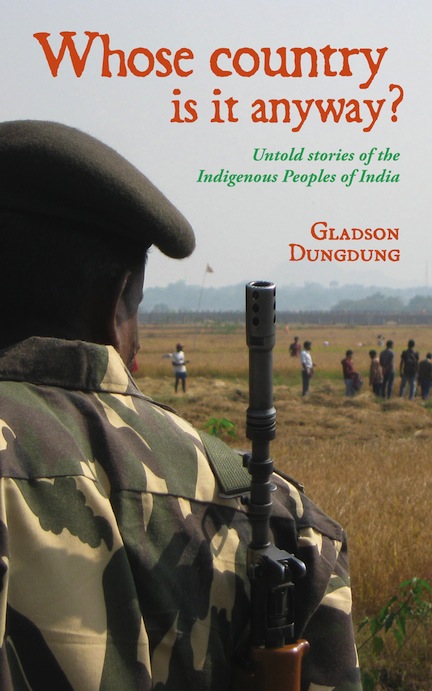
Crossfire: Gladson Dungdung’s new book in Hindi is out!

Crossfire Cover

Gladson and Sanjay Krishna have co-authored a collection of stories from the Red Corridor, highlighting voices of Adivasis who’ve been caught in the military conflict between the government and the maoists. Once a forest in peaceful existence, Saranda has become the stage of this continuous abuse of human rights.

Narrated in the honest and passionate style Gladson is known for,with the addition of Sanjay’s investigative journalistic experience, Crossfire is meant to be a new basic reference to understanding the lives and struggles of the indigenous peoples of India.

The book is already available at our dedicated bookstores, People Tree and Earthcare Books (you can order it online from them here: http://www.earthcarebooks.com/).

To get a feel of the book, download the introduction written by Swami Agnivesh here:

Introduction to Crossfire by Swami Agnivesh