adivaani

adivaani

adivaani titles @ International Kolkata Book Fair

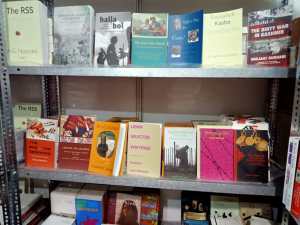
Find adivaani titles at LeftWord Books

Hall no-1, Stall no-15. (Closest entrance gate no: 3)

Central Park Mela Ground, Salt Lake, Karunamoyee crossing, Kolkata

Wed, 29 Jan, 2020 – Sun, 9 Feb, 2020 / 12 – 8 PM

Two out of print titles: We come from the Geese and Angor are back in stock as well.


May Day Bookstore sells adivaani’s books!

You can find our catalogue at LeftWord’s famous bookstore in Delhi :

May Day

2254/2A Ground Floor Shadi Khampur New Ranjit Nagar Shadipur
110008 Delhi

Ph. 011 2570 9456

People Tree, Goa

When in Goa, you can buy adivaani’s books here:


People Tree

Villa No. 6, Saunta Vaddo, Bardez,

Assagao, Goa 403507

Open | Monday to Sunday | 10am-11pm

Behind the Indian Boom, an exhibition in London and its catalogue


Catalogues attract catalogues—who knew? We had just finished Mark Elliot’s exhibition catalogue—Another India: Explorations and Expressions of Indigenous South Asia, when Alpa Shah, who’d been to the exhibition contacted us  to collaborate on another one.  The London School of Economics, Department of Anthropology and the School of Oriental and African Studies, SOAS, at the University of London were planning an exhibition dealing with the exclusion dalits and Adivasis suffer under the neoliberal economic policies applied in India. With the scholars behind the project approaching adivaani our newest title in our imprint One of Us came to life —  Behind the Indian Boom: Inequality and Resistance at the heart of economic growth.

In this volume, our readers can explore the powerful collection of images displayed at the Brunei Gallery of SOAS, that tell the stories of everyday, backbreaking labour that our peoples engage in to survive in this country. These images are testimonies of Adivasis and Dalits living with rights denied, identities, culture and languages undermined.

So please, grab a copy at our usual online platforms and bookstores too or buy it directly from us with at Instamojo.

Here’s a little treat—a preview of the introductory paragraphs of the book:

Much has been made of the boom currently taking place in India. One of the world’s fastest growing economies, it is predicted that by the middle of the century India will be one of the two largest, alongside China, leaving the West behind. But what does this growth look like for the people on whose land and labour it is based?

Although India is now home to more than a hundred billionaires, around 800 million people still survive on less than two dollars a day, and eight Indian states have more poor people than twenty-six of Africa’s poorest countries put together. It could be said that while the wealth of the West is founded on colonising other countries, the extreme wealth of a small minority in India is based on colonising parts of its own country and its people. Since the 1990s, when India liberalised its economy, foreign corporations have also been investing in India, benefiting from and also exploiting its resources and its cheap labour.

BEHIND THE INDIAN BOOM travels across the country to meet some of its Dalits and Adivasis—its low caste and tribal communities—historically stigmatised
as ‘untouchable’ and ‘wild’, in order to understand the roles they play in the Indian and the wider global economy. Despite India’s significant economic growth, these tribal and low caste communities remain at the bottom of its social and economic hierarchies. Though economists have said that some advances have been made in the reduction of absolute levels of poverty, they have also shown that some groups have fared much worse than others and that income and wealth inequality is increasing in India. Adivasis and Dalits are some of the people who have gained the least from growth in India and, as this visual essay shows, millions have lost out because of it. They are a source of cheap labour from which much of the world economy benefits, and some of the lands on which they have traditionally lived for generations are today important crucibles of global industry. Dalits and Adivasis count for more than 200 million and 100 million people respectively; that is a staggering one in twenty-five people in the world. Their situation also reveals insights into the conditions of other oppressed people across the globe.

BEHIND THE INDIAN BOOM draws on material collected by researchers affiliated with the London School of Economics, Department of Anthropology, Programme of Research on Inequality and Poverty. It also includes the work of local journalists and activists. The social anthropologists involved have lived for several years, sometimes decades with the people whose lives they are documenting. The aim is to give a sense of the everyday struggles that Adivasis and Dalits go through
to survive in the contemporary economy, and also their fight back against the situations they find themselves in.

Another India: an exhibition and a book

The exhibition Another India: Explorations and Expressions of Indigenous South Asia, opened on the 7 March 2017 and will continue until April 2018 at the Museum of Archaeology and Anthropology (MAA), Cambridge University.

Curated by Dr. Mark Elliot, this exhibition “explores the tangled histories of artefacts from indigenous populations in India and how they came to be in the collections in Cambridge.”

The assemblage being exhibited is a combination of artefacts, paintings and photographs from MAA’s collection, many of which have never been exhibited before, and artworks by contemporary artists from the Indigenous and Adivasi communities represented.

We’re happy to announce that the catalogue from the ongoing exhibition—which is a remarkable account of the objects, the people who made them and who collected them and their complex legacies, is now available for sale at adivaani’s regular distribution channels.

Legal Status

adivaani was registered as a Trust with the Additional Registrar of Assurances in Kolkata, West Bengal on July 19, 2012. Our Registration number is 4326.
adivaani is registered u/s 12AA (1)(b)(i) of the Income Tax Act 1961, and has the following tax exemptions:~ Approval under section 80G (5)(iv) of the Income Tax Act,1961 (50% exemption).

Adivaani and Tribal Intellectual Collective India’s second book is out!

TAS3

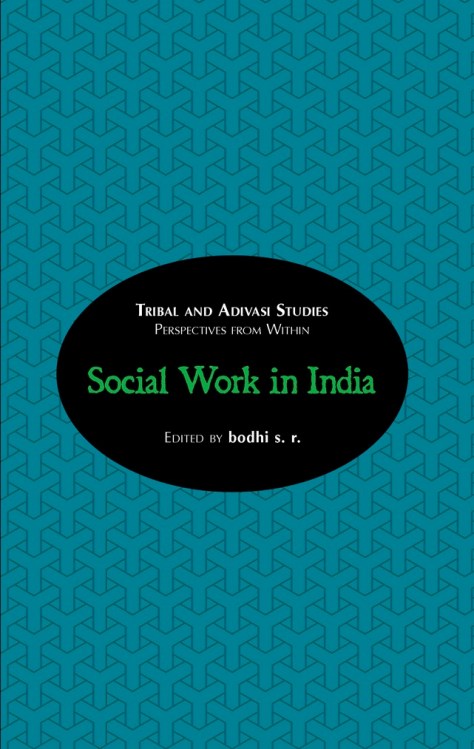
Adivaani and the Tribal Intellectual Collective India is proud to present its second title from the Tribal and Adivasi Studies series—Social Work in India, Edited by bodhi s. r.

bodhi. s. r sums up the book for us: ‘This specific volume of the TAS series attempts to unravel key constitutive elements of perspectives from within in Tribal and Adivasi Studies. This being a subject area not sufficiently explored by scholars and whose myriad questions remain definitively unanswered to this day, both in academia and within progressive activist scholarship. Evidences to assert and augment propositions related to unraveling this distinct methodological position have been sourced from a practice discipline–social work. Discursive in nature and drawing extensively from the experiences of those who have directly engaged in critical and strategic practice in Tribal/Adivasi empowerment, this volume; also an act in epistemological reconstruction, envisages asserting and achieving greater depth and clarity of the said perspective in the identified subject domain’.

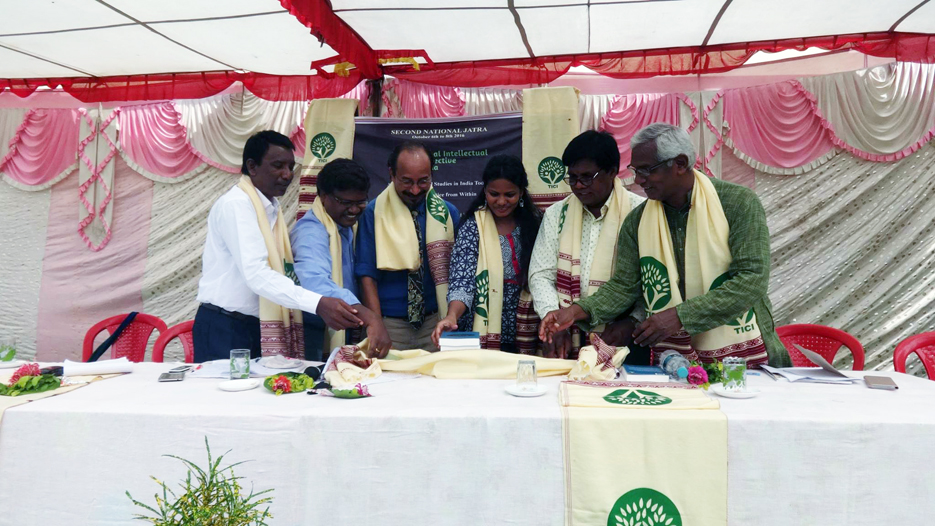
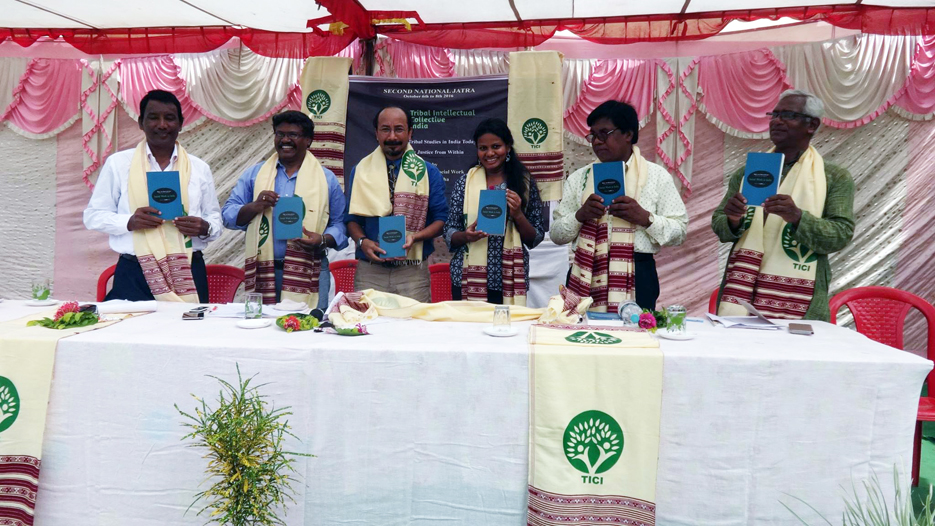
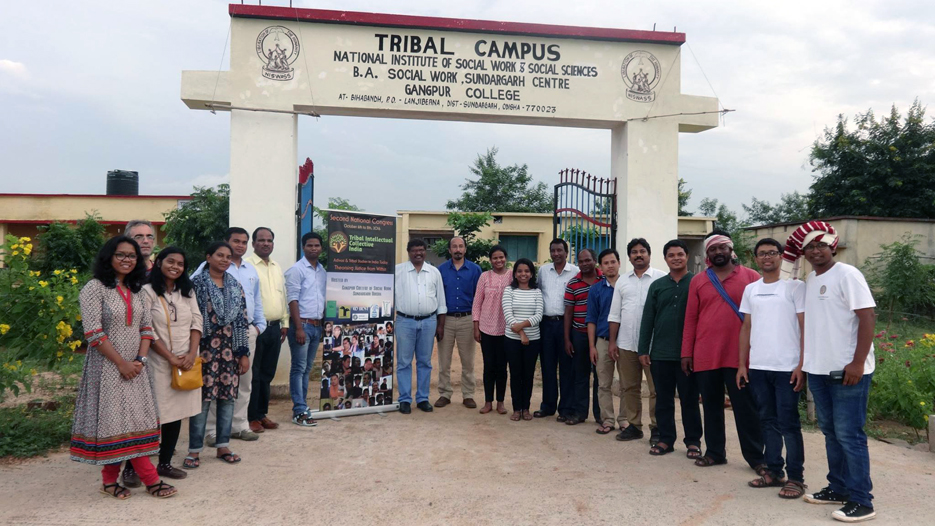
We released the book at the Second National Congress in Bihaband, Orissa on 6th October 2016 at the inaugural session of the three-day jatra.

Here are some snapshots from the book release, the congress and the tribal and adivasi students, scholars and postgraduate students who attended the event.

Ruby

Illustrated Pursuits: Why we chose to do the book?

santal-weapon

Illustrated Pursuits by Ngaire Gardner


Almost two years ago adivaani received the proposal for Illustrated Pursuits: a collection of drawings, published articles and maps by Walter Stanhope Sherwill, who spent a total twenty-seven years in India since he first arrived as a young man in 1834 to work for the British East India Company. He served as an ensign, Assistant Revenue Surveyor, Revenue Surveyor of what was then known as the Bengal Presidency. He held positions of Lieutenant; Captain—a position he held until 1859 when he became Major Sherwill. On his retirement in 1861 he was given the title Honourable Lieutenant Colonel.

When Ngaire Gardner, the author, a retired school teacher who taught History of Art, Classical Studies, Visual Arts, Design and Photography and also great-great-granddaughter of Sherwill contacted us; we knew little of Sherwill except that the iconic drawing of Sidhu Murmu in jail, one of the brothers famous for leading the Santal Rebellion 1855-57, was in all probability drawn by him.
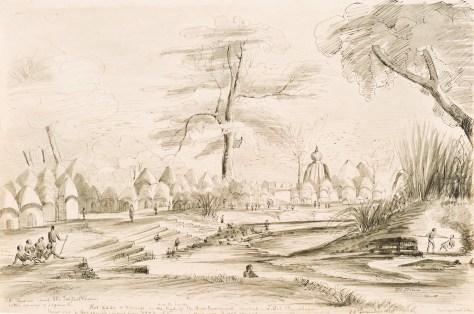
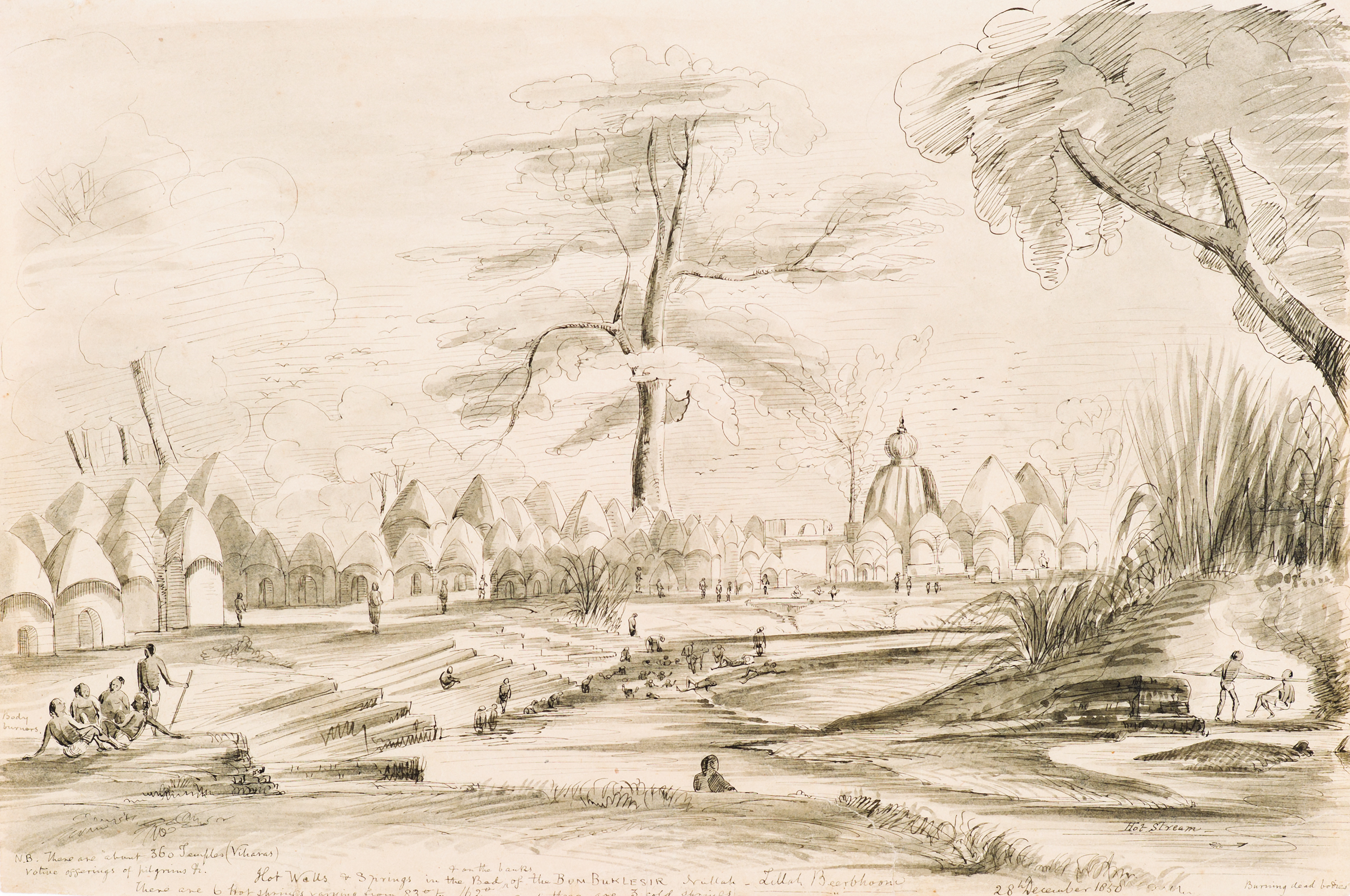
‘Hot Wells and Springs in the bed and on the banks of the Bum Buklesir Nullah – Zillah Beerbhoom’; W. S. Sherwill, 1851; Indian ink on paper; © Dunedin Public Art Gallery; 40.8 x 27 cm.

That image has been in circulation and used by Santals and Adivasis for years now to represent and assert our identity rights and self-determination.

What are the odds that an Adivasi publisher comes in contact with Sherwill’s descendant and has access to more material that serves as the only window to the life and times of our people over a century and half ago. Well, it happened and Illustrated Pursuits came to life.
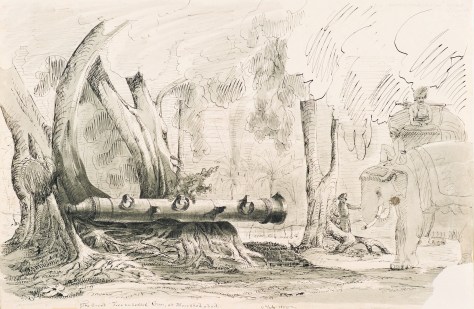
‘The Great Tree embedded Gun, at Moorshedabad’; W. S. Sherwill, 1850; Indian ink on paper; © Dunedin Public Art Gallery; 41 x 27 cm.

Sherwill’s “Notes Upon a Tour of the Rajmahal Hills” (1851) and “Notes Upon a Tour of the Sikkim Himilayahs” (1852), both published in the Journal of the Asiatic Society of Bengal and included in this book, give us a glimpse of the tribal people and their customs in those regions. Actually, Sherwill’s work does reflect British colonial positions and this book will help us engage with those thought patterns and approaches.

We did not want to pass up the prospect of having this historical material, curated in one place and made available to the descendants of Sidhu and Kanhu Murmu and the others who have been represented in Sherwill’s drawing.

Ngaire Gardner sums up the intention of the book: ‘the consequences of British colonial attitudes to the land, resources and indigenous population of India continue to reverberate today and readers will inevitably bring their own perspectives to Sherwill’s images and words. My aim has been to share the material he has left behind and to allow readers to form their own opinions of his legacy’ .
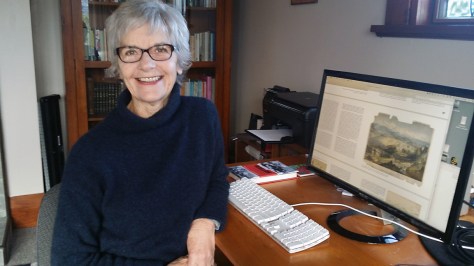
Ngaire Gardner

Ngaire Gardner

The book, from our imprint ONE of US, is now available for you to read. Go ahead and grab your copy.
boar

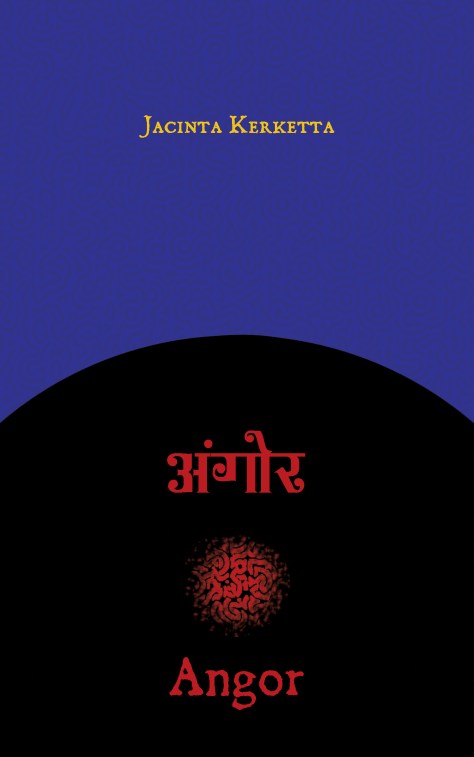
Jacinta Kerketta’s first poetry book: Angor

Angor

Our authors and readers make adivaani what it is…they are the fuel and passion that keeps our work going.

As proud as we are to announce our first poetry book; the poet and her brilliance far surpass everything we stand for.

Do join us at the launch of Jacinta Kerketta’s first collection of bi-lingual poems in Hindi and English: Angor on Friday, the 20th of May, 2016 in Ranchi, Jharkhand.

Jacinta’s Angor–meaning Ember in the local Adivasi dialect–has been translated into German, Glut (Hindi-German) in collaboration with Draupadi-Verlag and Jacinta and Ruby will embark on a tour to Germany soon after, promoting both books.

We invite you to come over and interact with Jacinta and hear her recite some of her poems.

Venue: Dr. Camil Bulcke Hall,

St. Xavier’s College. Purulia Road

Time: 15:30 hrs.

Hope to see you all there.

adivaani books at the International Kolkata Book Fair, 2016

IKBF-Logo-Header

Where: Stall 205, Nagarik Mancha

Venue: Milan Mela, Kolkata. (Near E. M. Bypass, Science City)

Dates: January 26th, 2016 – February 7th, 2016

Time: Everyday from 12 PM – 8 PM

Ruby Hembrom at the Jaipur Literature Festival 2016

JaipurLit

Join Ruby, adivaani’s Executive Director, at the following sessions:

1. Jaipur BookMark, Thursday, January 21, 2016
Time: 12:30 pm to 1:30 pm
Session No.: 2 (Main Stage)
Session Name: An Indian Reader
Speakers: Nirmal Kanti Bhattacharjee, Rita Kothari, Jerry Pinto, Shailesh Bharatwasi and Ruby Hembrom in conversation with Manisha Chaudhry

2. Jaipur Literature Festival, Saturday, January 23, 2016
Time: 3:45 pm to 4:45 pm
Session No.: 98 (Baithak)
Session Name: Adivaani: The Indigenous Literature of India
Speakers: Hari Ram Meena, Ruby Hembrom and Peter Anderson in conversation with Mohini Gupta

3. Jaipur Literature Festival, Saturday, January 23, 2016
Time: 5:15 pm to 6:15 pm
Session No.: 103 (Mughal Tent)
Session Name: A Room of One’s Own
Speakers: Ila Arab Mehta, Anuradha Roy, Ira Pande, Alka Saraogi, Ruby Hembrom in conversation with Anjum Hasan, introduced by Namita Gokhale.

adivaani books at the New Delhi World Book Fair 2016

logo


Where: Sanskriti Book Distributors, Hall No. 6, Stall No. 87, near Gate no. 2, Pragati Maidan.

Venue: Pragati Maidan, Mathura Road, New Delhi, 110002.

Dates: January 9th to January 17th, 2016.

Time: Everyday 11 a.m. to 8 p.m

adivaani’s new imprint One of Us brings out Sylvan Tales: Stories from the Munda country

OU01

In the past we’ve received manuscripts and proposals from Non-Adivasi authors, activists, scholars and researchers who wished to publish with us and we turned them down as a policy as we were creating a niche space for ourselves and they’d anyway have better chances to be published by established, mainstream publishers.

Three years on we realized that there were some Non-Adivasi’s who’ve been so closely associated with us and our issues; who’ve build trusting relationships with us that their voices were important to include to create the larger documentation, adivaani database. After much deliberation we decide to start One of Us to include such narratives.

One of Us is a celebration of outsider-insider collaborations, associations and relationships. adivaani wouldn’t be what it is without such collaborations and neither would our Adivasi movements and struggles.

Samar Bosu Mullick’s Sylvan Tales: Stories from the Munda country is the first title under One of Us; traversing through Munda terrain picking up sights, sounds, smells and flavours from it.

CoverFinal

Sylvan Book Release

Samar Bosu Mullick (centre) at the official release of Sylvan Tales: Stories from the Munda country in Ranchi on the 24th of October, 2015.

Samar (Sanjay) Bosu Mullick has been engaged in the Adivasi struggle for identity, autonomy and rights to resources since 1968. This collection of 14 stories is embedded on facts that he as an activist encountered during the last 45 years of his being among the characters of the stories.

Do pick up the book and read on to savour the stories.

In Telugu now: Our Santal Creation stories

A few months ago Manchi Pustakam, Secunderabad acquired the Telugu rights to our illustrated books on the Santal creation stories.

We are pleased to share that the books are out and can be bought at Kinige. Click on the images to have a look:


Sosobonga, the creation story of the Mundas, is now out

CoverFinalk

In another installment on the works by Dr. Ram Dayal Munda, we are happy to present a bi-lingual volume (English and Roman Mundari) co-authored by Ratan Singh Manki.

Sosobonga, the prayer of the Soso tree, is the ultimate expression of love and respect for our Mother Earth within the Munda and the Asur peoples.

Orally narrated the epic aims not only to present how human life came into existence but also introduces us to a story in search of equilibrium and the restoring actions of reciprocity among humans—between themselves and other beings.

We hope that our readers will have a deeper understanding of Adivasi cultures and through the simple and poetic passages of the book, love this ancient, yet always fresh ritual of fertility, sharing and living within the boundaries of nature.

But, hush, the priest is about to start telling the story. He is passing his right hand over the rice in the winnowing fan resting on his lap… grab your copy and follow his voice.

Get our books on Amazon.in, ilandlo and Walking Bookfairs


amazon-india-logo


ilandlo+logo+2


Walking BookFairs

HIG 34 Phase 1. HB Colony. Khandagiri. Bhubaneshwar-751030


More options now for our dear readers to purchase our books online.

Happy book shopping!

adivaani is now on flipkart

flipkart_logo

We are happy to share that adivaani now has another platform where our books can be purchased.

Happy Reading!

Release of Becoming me, our first Adivasi PICKLE book

The first edition of Adivasi PICKLE has formally and successfully come to an end.

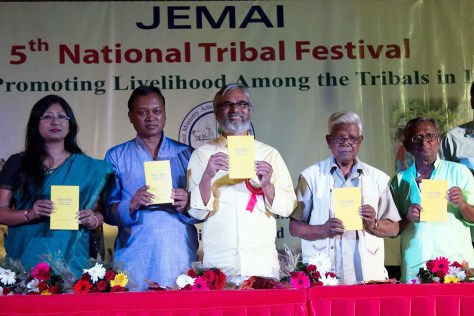
Becoming Me by Rejina Marandi was released on Saturday, the 25th of October, 2014 at the author’s hometown in Assam.

The event was a celebration of stories, storytelling and storytellers soaked in Adivasi flavours.

The Forest Guest House Campus, Srirampur, Santal Colony, Kokrajhar District was the venue and the open air setting amidst trees made for an event befitting Adivasis’ love for nature. Sadri and Santali music played through the sound systems setting the stage for festivity.

Guests—family, friends, dignitaries, activists, journalists, well-wishers arrived from all corners of Assam, some even taking a train journey to share in Rejina’s grand day. Welcomed in traditional ways by washing of feet and being gifted a panchi; we felt at home.

Rejina looked lovely in her traditional Santali clothes. It was such a proud moment to unwrap her books from the panchi that held them together and unveil it to everyone present.

She says Becoming Me is her part of the effort to transform oral tradition to the written form. “Today’s Present is tomorrow’s History. So, let each one of us start sharing our part of the story in the written form”, she said.

adivaani thanks ASSU (All Santal Student’s Union), ASSAA (All Adivasi Students’ Association of Assam), Wilson Hansda and Rejina Marandi for putting this book release event together so beautifully and everyone who addressed the gathering and attended it.

Congratulations once again to Rejina Marandi! May our stories travel far and wide.


Click on any of the photographs to view the entire gallery.


Felix Padel reviews Dancing on our turtle’s back

This book is a timely affirmation of Indigenous together with environmental issues. Dancing on our turtle’s back refers to the continent of America, and implicitly Mother Earth, as the turtle we dance on.

Cover

Because we belong to the land—a special introductory section for the Indian edition makes clear what Indigenous peoples worldwide have in common, alongside an infinite array of differences—for one, an environmental consciousness in the face of ‘State-facilitated environmental devastation’; for another, a history of Resistance and Resurgence, ‘reclaiming and reoccupying our homelands’. In Canada, the indigenous movement known as ‘Idle No More’ has created potent political waves recently, reversing past takeovers. In India we still witnesses the opposite—thousands of Indigenous communities attempting, often against massive odds, just to hold onto their lands against a mass wave of corporate invasions.

Read the complete review here

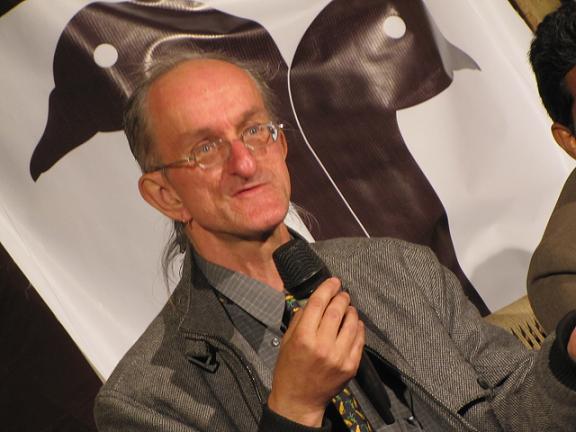
Felix PadelFelix Padel at the release of our first two books at the World Delhi Book Fair, February 2013

Felix Padel is an Anthropologist and the author of The Sacrifice of Human Being: British Rule & the Konds of Orissa (1995, 2000), Sacrificing People: Invasions of a Tribal Landscape (1995, 2010), Out of This Earth: East India Adivasis and the Aluminium Cartel (2010 with Samarendra Das) and Ecology, Economy: Quest for a Socially Informed Connection (2013 with Ajay Dandekar & Jeemol Unni ) and several articles emphasizing the wider significance of Indigenous issues.

Banam Raja, exploring our musical roots

adivaani has taken its archiving work to include documentary films now. Banam Raja is our first production exploring Adivasi musical traditions.
At the end of the day, Santals return to music to become whole again. They bring out their instruments into the courtyard and music, lyrics and song turn into stars in the night sky. Our musical traditions are millennial.
The banam is a stringed instrument. Banams are the lutes and the fiddles of the Santal people. They are made from locally available material–wood, vegetables and animal hide. The most common banams still made and played by Santals are the Dhodro Banam, the Reta Banam and the Phentor Banam.
This video is a tribute to our artists, who have kept our culture alive through generations.


During the process of filming we were able to record some songs by Santal musicians. Here’s a sample of their joy and pride in music—unrehearsed and performed in natural surroundings.


Adivasi PICKLE: the second edition of our writing prize is here

Adivasi Pickle

It’s that time of the year again—to come together as a community of Indigenous peoples and join the world in celebrating one day in our honor—9th August.

adivaani wants to commemorate this occasion by serving the second portion of Adivasi Pickle.

Pickle is the perfect accompaniment to spice up any spread and the one key element common to every Indian kitchen and palate.

How about some Adivasi pickle? A pickle made of indigenous ways and thinking—the perfect accompaniment to our present—with ingredients that help us understand how our ancestral ways have preserved and sustained the earth, until newer ways dismissed them as primitive and we became a resource to be extracted, exploited and ignored. Ingredients that help refurbish traditions and knowledge webs, and ensure our future.

adivaani is therefore calling Adivasis to share more about ourselves. We’ve instituted a small prize of a book, out of love, on the International Day for the World’s Indigenous Peoples, August 9th, 2014. We’re short on what we can give, but we’re long on good wishes, hope and solidarity: you write, we publish. That’s the deal!

We believe the time for us to do things our own way is now. We want this event to be a celebration of a communion of, by and for Adivasis—right from our sisters and brothers sharing and chronicling their personal narratives, to the publisher, not forgetting the jury formed of Adivasi intellectuals, scholars and artisans.

Join us, spread the word and…

Click here to participate

Unique tales of India’s tribal communities: Gulf News

gulf news

Anyone collaborating with Ruby Hembrom is sure to widen his or her mental bandwidth. For she not just thinks out-of-box but also invests her soul and spirit into the work she undertakes.

Kolkata-based Hembrom runs Adivaani, a publishing house for adivasi (tribal) literature. It was launched by a group of amateurs that included her friend Joy Tudu, Luis A Gomez, a Mexican journalist, and Boski Jain, a graphic artist.

Read the rest here.

Publishers fight odds to keep tribal literature alive: The Times of India, Ranchi

The city is at the heart of a quiet but slow revolution, with publishers, small and big, taking tentative steps in the field of tribal literature. One such group is Adivaani, a database which collects, publishes and preserves tribal folklore and culture.

Read the rest here.

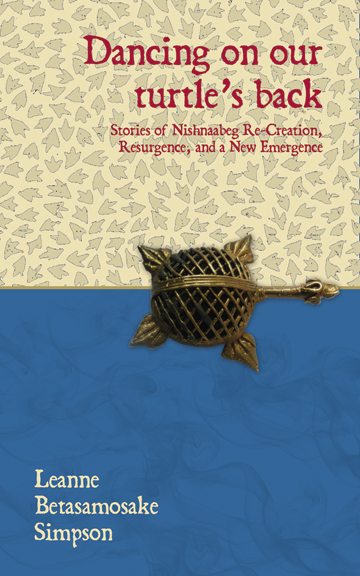
Dancing on our turtle’s back: Leanne Betasamosake Simpson

Cover

In the end of 2012, adivaani was following the emergence of the Idle no more movement of the Aboriginal peoples in Canada comprising the First Nations, Métis and Inuit peoples and their non-Aboriginal supporters in Canada. This in their own words is a peaceful revolution to honour Indigenous sovereignty and to protect the land and water.

It was during this interface that we came across Canadian indigenous scholar and writer Leanne Betasamosake Simpson.

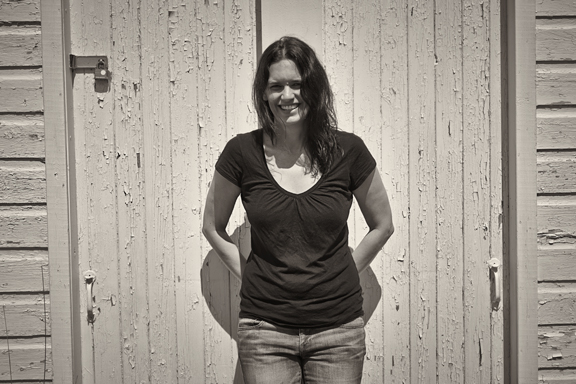
Leanne Betasamosake SimpsonWe started reading her and were so inspired by her words, vision and storytelling of the indigenous imagery that we wanted our Adivasi brothers and sisters to share in the joy and hope we found in her writings. We believe sharing thoughts, experiences, ideas and stories between indigenous peoples is one way of building solidarity in a world where despite geographical barriers our lives are intertwined.
We went ahead and bought the rights to her insightful book Dancing on our turtle’s back and now have the Indian edition ready for you to read. Get our books at our dedicated bookstores, People Tree, Foreign Publishers and Earthcare Books (you can order it online from them here: http://www.earthcarebooks.com/).

We’ll have more to share on Leanne and her work soon. In the meantime here’s Leanne’s introduction to the Indian edition of Dancing on our turtle’s back especially for you.

Introduction to the Indian edition of Dancing on our turtle’s back.


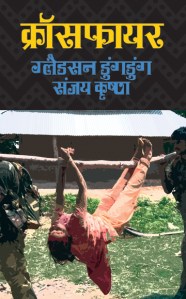
Crossfire: Gladson Dungdung’s new book in Hindi is out!

Crossfire Cover

Gladson and Sanjay Krishna have co-authored a collection of stories from the Red Corridor, highlighting voices of Adivasis who’ve been caught in the military conflict between the government and the maoists. Once a forest in peaceful existence, Saranda has become the stage of this continuous abuse of human rights.

Narrated in the honest and passionate style Gladson is known for,with the addition of Sanjay’s investigative journalistic experience, Crossfire is meant to be a new basic reference to understanding the lives and struggles of the indigenous peoples of India.

The book is already available at our dedicated bookstores, People Tree and Earthcare Books (you can order it online from them here: http://www.earthcarebooks.com/).

To get a feel of the book, download the introduction written by Swami Agnivesh here:

Introduction to Crossfire by Swami Agnivesh