Unknown's avatar

About adivaani

A platform for adivasi expression based in Kolkata.

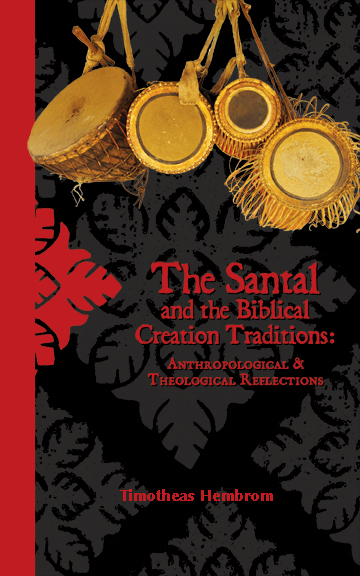
Sosobonga, the creation story of the Mundas, is now out

CoverFinalk

In another installment on the works by Dr. Ram Dayal Munda, we are happy to present a bi-lingual volume (English and Roman Mundari) co-authored by Ratan Singh Manki.

Sosobonga, the prayer of the Soso tree, is the ultimate expression of love and respect for our Mother Earth within the Munda and the Asur peoples.

Orally narrated the epic aims not only to present how human life came into existence but also introduces us to a story in search of equilibrium and the restoring actions of reciprocity among humans—between themselves and other beings.

We hope that our readers will have a deeper understanding of Adivasi cultures and through the simple and poetic passages of the book, love this ancient, yet always fresh ritual of fertility, sharing and living within the boundaries of nature.

But, hush, the priest is about to start telling the story. He is passing his right hand over the rice in the winnowing fan resting on his lap… grab your copy and follow his voice.

Get our books on Amazon.in, ilandlo and Walking Bookfairs


amazon-india-logo


ilandlo+logo+2


Walking BookFairs

HIG 34 Phase 1. HB Colony. Khandagiri. Bhubaneshwar-751030


More options now for our dear readers to purchase our books online.

Happy book shopping!

adivaani is now on flipkart

flipkart_logo

We are happy to share that adivaani now has another platform where our books can be purchased.

Happy Reading!

Adivasi PICKLE 2014: A call by Rejina Marandi

Adivasi Pickle

adivasi PICKLE is an interesting platform to bring forth the oral knowledge of Adivasi people in the written form. There are several stories, which have slipped out of the minds of people or have been suppressed inside, and this determines who we are today. History is important hence, it is important to engage with adivasi PICKLE and leave behind a story. And this story will tomorrow be regarded as history.

Language might be barrier for many of us but adivaani’s Director Ruby Hembrom says,“Language should no longer stop us to write, we should express our knowledge in whatsoever language or skill we possess. This venture is a joint effort of the author and the publishers where they work hand in hand to produce the best out of the raw.

In the first effort of adivasi PICKLE 2013, I was given one year to complete the book. When I sent them my first draft, the publishers read it, edited it and provided suggestions where I got the chance to re-think and modify my writings. It was indeed a new experience to get into the world of literature which I had never thought before.

Yes, we all enjoyed the venture and celebrated the fruits of it amidst many intellectuals, well wishers, media persons and near and dear ones. Hoping to see more than that from the upcoming 2014 edition. I wish all the participants the very best. If you are still holding on to a story; just send it in as an entry.

Thanks to adivaani for this amazing platform, the reward, recognition and the lasting memories.

Best wishes,

Rejina Marandi

Last call to participate in adivasi PICKLE 2014.

LAST DATE TO ENTER COMPETITION: 31st December, 2014.

Introducing adivaani’s new Board of Trustees and Advisers

boardoftrustees

adivaani has in the last two and a half years travelled far and wide; covering more ground than planned, connecting with more people than anticipated and have had associations and networks open unexpected doors. At the end of the year as we pause to catch some breath we realise we have to consolidate all that we have worked for and towards and make every experience count.

We’ve been fortunate to have the commitment of three individuals to contribute to this journey— Impsupenla Ozükum and Judith Herenz.

So we continue to urge you to support us as you’ve been doing—write, phone or drop in and keep your involvement with us going. So feel free to contact me.

Ruby Hembrom

Executive DIRECTOR

NEW BOOK: Adi-dharam, the religious beliefs of the Adivasis of India

CoverLow

Ram Dayal Munda’s Adi-dharam is an important text highlighting and questioning the religious identity of the Adivasis, contributing to the effort of reconstruction of the religious aspect of that heritage, a process that he started during his lifetime.

In it’s third edition now, co-published with BIRSA and sarini, Adi-dharam is available for your reading and consideration.

We hope for you to engage through this book with the vision elucidated by an Adivasi figure as significant as Ram Dayal Munda.

Read the Preface of this new edition written by Samar Bosu Mullick

Release of Becoming me, our first Adivasi PICKLE book

The first edition of Adivasi PICKLE has formally and successfully come to an end.

Becoming Me by Rejina Marandi was released on Saturday, the 25th of October, 2014 at the author’s hometown in Assam.

The event was a celebration of stories, storytelling and storytellers soaked in Adivasi flavours.

The Forest Guest House Campus, Srirampur, Santal Colony, Kokrajhar District was the venue and the open air setting amidst trees made for an event befitting Adivasis’ love for nature. Sadri and Santali music played through the sound systems setting the stage for festivity.

Guests—family, friends, dignitaries, activists, journalists, well-wishers arrived from all corners of Assam, some even taking a train journey to share in Rejina’s grand day. Welcomed in traditional ways by washing of feet and being gifted a panchi; we felt at home.

Rejina looked lovely in her traditional Santali clothes. It was such a proud moment to unwrap her books from the panchi that held them together and unveil it to everyone present.

She says Becoming Me is her part of the effort to transform oral tradition to the written form. “Today’s Present is tomorrow’s History. So, let each one of us start sharing our part of the story in the written form”, she said.

adivaani thanks ASSU (All Santal Student’s Union), ASSAA (All Adivasi Students’ Association of Assam), Wilson Hansda and Rejina Marandi for putting this book release event together so beautifully and everyone who addressed the gathering and attended it.

Congratulations once again to Rejina Marandi! May our stories travel far and wide.


Click on any of the photographs to view the entire gallery.


Frankfurt Book Fair 2014

Frankfurt Book Fair

Just to share with you that Ruby Hembrom, adivaani’s founding director and storyteller is on her way to attend the Frankfurt Book Fair—the biggest confluence of the publishing world. She’s traveling as a guest of the Visitors Program of the Federal Republic of Germany.

This is an exciting time for adivaani—for such a young publishing venture to partake of and experience this event.

Our gratitude to everyone at the German Consulate in Kolkata for extending this invite to us.

Decolonizing and Storytelling: an interview with Leanne Betasamosake Simpson

Leanne Betasamosake Simpson


We published Leanne’s Dancing on our turtle’s back in India because we think a resurgence of indigenous consciousness and thinking processes is very much needed. At a time when many indigenous people are losing awareness of deep spiritual links to the land; when Indigenous cultures face many levels of genocide; and when movements of resistance to unjust takeovers and repression need to call on ancient, enduring forms of knowledge lying dormant in the land and people’s hearts.

We then decided to interview Leanne knowing that her experience and insight would help our readers, activists and journalists to understand why the book matters to us. Here’s the transcript of the conversation between Leanne and Ruby, on July 18th, 2014.


The way you refer to elemental concepts of Indigenous knowledges (Nishnaabeg knowledge and culture) contrasts mobilisations of resurgence with conventional social science terminology such as ‘social movement theory’. Is it just a change in terminology or do you believe it is a shift in the perception of say, the spirit of our struggles?

I think it’s a fundamental shift for me because I think for a long time in Canada and in North America, indigenous peoples have been positioned as not having knowledge. Individually we’ve sort of been steroetyped as being stupid. We’ve been unknowing, we haven’t been a thinking people and that was very deliberate because that’s how colonialism and colonisation and now settler colonialism really operates. So really, it’s something that has a very personal impact—a way of erasing indigenous peoples from the land and erasing our intelligence and our presence.

For me it was very important to go back and base not just the book but my life, practice and my life work in recovering and amplifying and understanding how my ancient ancestors and my contemporary elders think.

I was propelled in my life to be able to think as a Nishnaabeg person, with our philiosphies and with our concepts, the way that we interact and construct the world and live in that world. And the driving force was a very personal and very intimate one I think. The desire in myself to be able to do that because one of the things that I’m really worried about is that if we don’t put a substantial amount of effort into that and into raising generations of children who can think like that, then the knowledge system doesn’t continue. It doesn’t continue to be reborn each generation and I think that we need a kind of transformation in Canada and really in the world in terms of our relationship to land, our relationship to each other. I think that we have to make a radical shift. So I see a lot social movements responding to state governments, they are responding to legislation, they’re responding in a way that’s very necessary in terms of resistance and in terms of protecting what we have and advocating for our rights. But I think of this other longer term vision of bringing about a radical transformation in myself and in my own little family, but also in my community and in connecting with indigenous peoples in other parts. I think that’s where the resurgence part is—to me that’s a different way of thinking. The idea that by sort of changing, by sort of aligning ourselves with our own philisophies and concepts and traditions, and embodying those changes in us. And then it changes how we see things and then I think when you have generations raised back in that indigenous intelligence; when you have generations of children empowered and having indigenous intelligence, you’re going to frame the problems differently, they’re going to frame the solutions differently. So I also think in terms of resistance you require people that are really connected to their land, having fallen in love with the land, then you are reviving local economies and have really strong relationships to each other. I think it becomes very difficult for capitalistic forces to remove natural resources for development and all those things that try to pull us away from the land. It becomes much more difficult for those processes to operate. So I think it also has a really big benefit in terms of resistance as well.


India officially has claimed that all Indians are indigenous on many platforms, enabling it to shirk responsibility of international protections for indigenous rights. What do you think about the reluctance to grant us our rights as indigenous peoples?

Well I think we are in a similar position in Canada in that our government is extremely reluctant to make any kind of principled statement or stand upon that and I think we get caught up in believing this. When I look around the relationship doesn’t change, which is still one of domination, oppression and erasure. So I think that colonialism sets up this situation where it’s very much us versus them and when I think indigenous peoples and our political traditions had some ideas of how to live and how to live together. In Canada we’re really set aside so that the Canadian state could really take hold of the land and develop it for natural resources, gas and forestry and so I think that their reluctance to acknowledge our rights is because ultimately we call in to question the history of these states, we call in to question the way that they’ve positioned themselves in international bodies as being in states that don’t have indigenous people or don’t have any problems in terms of human rights around indigenous peoples, and so I think you are right: it’s very much a way of state side-stepping the relationships, side stepping the responsibility and really perpetuating the problem and not talking about the elephant in the room. Like not talking about what the root cause of these problems are and then not being able to come up with any kinds of solutions that reproach justice, reproach respect, reproach honour and so I think indigenous people have to work very, very hard to be critically aware of what’s going on at that state level, and to undo that so that we don’t get caught up in wanting and restructuring ourselves, so that we want and will do anything to get that recognition from states. I think that’s kind of dangerous.


Indigenous resistance is the new terrorism in India. What kind of repression have you personally faced in your work as an activist? Tell us more about your experience in Idle No More.

I’ve been very involved in the recent Idle No More movement and I’ve been an activist now for two decades. I think in Canada there’s also the government trying to position us as terrorists and as radicals and as trying to tear apart the country, and I think indigenous women have played a really critical role in this because in Idle No More we repeatedly articulated to the media that our activism comes from a place of love, it comes from a place of love of the land, love of our culture and our languages and love of our families and so our motivation is very much to create better lives for our children where they can embody their culture, where they can speak their languages, where they can practice their spirituality, where they can live out as a Nishnaabeg or as indigenous people and that I think resonated with some Canadians because that’s something that Canadians take for granted—the ability to raise their children in a safe environment where our children can express who they are and for indigenous peoples we don’t have that—that’s not normal, thus we fight for that. And so I think a lot of our activism has been focused on trying to get our message through a very biased media. The government guards our movement in two ways. One is to sort of position us as crazy radicals that are violent and that are out to destroy things; and the other way is to draw us into these government controlled processes that are really designed at their core to maintain their status quo but they give the illusion that there’s going to be change and so sometimes a lot of our resistance gets funnelled into these policy building exercises that are just a waste of everyone’s time. But this takes our attention away from the real issues.

So I think as time goes on indigenous peoples anytime are resisting or getting lumped into that terrorist sort of pile but during Idle No More it became more difficult for the government to bring that on because we were doing our very traditional round dances with drumming and singing with our children in shopping malls. That was an expression of our love. We encouraged everyone to join in with us and dance and have a song and so I think it was challenging for people because they’re used to seeing us at blockades and protests and all of a sudden here we were in these public places celebrating our presence. And celebrating the best parts of who we are and sharing it and so it was the beginnings of a transformation but it’s very difficult because the state and the media are very invested in us being a threat.


To appreciate indigenous writing one needs a special kind of imagination. I love that you non-apologetically use words from your mother tongue to beautifully weave ideas, concepts and notions. How do non-indigenous peoples react to your writings?

When I first wrote this book, I didn’t think that anyone really outside of my close friends and family would read it. I write it very much for a Nishnaabeg audience and the lessons that I learnt is that you should always write for that audience that you love and then what you produce is something that you’re really proud of on your own terms.

I’ve had two reactions: the majority of non-native people have been very supportive and have found the book challenging because they’re shocked at what they don’t know, they’re shocked that we have a language, they’re shocked that I am by no means a fluent speaker, but I know some of my language and that we have these concepts that are actually very complex and challenging for them intellectually to get their heads around.

There was a class at the university of Toronto that was mainly non-native students that read the book and they said this was the first book that they had read in their lives that they thought wasn’t written for them as an audience and that was a very difficult pill to swallow for them and they couldn’t believe that there has been a book produced in Canada that wasn’t targeted towards them. That for indigenous peoples is very funny because all of the books are not targeted towards us. That, I thought, was a very interesting observation.

My publisher here is the only publisher in Canada that probably would have published that book knowing that the audience is going to be pretty small and if the audience is going to be indigenous, then non-aboriginal people are going to have difficulty around the use of my language and they were just so supportive and such a fierce protector of me and my process and I’m so appreciative of that because it’s very, very rare. I think had I gone to an academic press or a mainstream press that’s the part they would have had difficulty publishing, they would have wanted translations and not so much language so that it would be less cumbersome for the non-native reader. So that’s why I think you know small presses, networks of small presses are so critical for me as a writer, because I think that’s one of the parts of the book that I’m most proud of.

When I read another writer and I see words from their language I feel such a solidarity and I feel proud and I want my readers to feel proud of theirs, whatever indigenous cultures they came from. I think that’s so critical and so if while people have to switch to the glossary and interrupt their flow, I think that that’s worth it.


Was your becoming a public figure a deliberate move or was it accidental? How do you live with it?

I feel like I live a pretty simple life. I have two kids and I teach them at home and I spend a lot of time on the land and a lot of time in community. So my first reaction is ‘What, am I a public figure?’ And I don’t live in one of the bigger cities in Toronto and I think of what’s happened through Idle No More is that a lot of leaders have emerged and a lot of voices have emerged. I think that there’s a lot of different indigenous women and indigenous people speaking out and contributing to the conversation right now which is really wonderful, so I think it certainly was not deliberate. It certainly is something I’m not particularly comfortable with but it’s just really made me seek out a stronger connection to my own spirituality, to the land and my own community. I think you have to have a strong family and a strong community supporting you in order to have any kind of public life. But it’s in the things that mean the most—conversations like this and having people, different indigenous peoples throughout the world, throughout Canada connect to my work. That’s why I do the work I do. It’s not for any of the public part of it.


In the book you express how you discuss concepts and ideas with your elders. But we know you are also a professor. Can you talk to us about this job and how you live the experience of discussing and sharing with younger indigenous people?

I’m very honest as a professor and with my students. I am very much a learner in my own indigenous knowledge systems because I’m middle aged and I’m very much engaged as a language learner and as someone who is still really indebted to elders. So I’m very honest and the main way that I try to teach the students is just through modelling my own life and I’m not perfect and I make a lot of mistakes and this is difficult. Resurgence is a difficult thing and decolonizing is a difficult thing and it’s not always clear what we should be doing or how we should be doing it. It’s an unsettling process for indigenous people, so I think the kind of teaching that I find most meaningful is when I am with students and I’m with elders on the land, outside of the university classroom and outside of the course outlines.

I try as much as I can in my life to make space for that, because that’s where the real learning takes place. I think that kind of education is the kind I’ve always been interested in. It’s the life long learning, a community meshed learning process and that’s where Dancing on our turtle’s back comes from. It comes from that community of learners and indigenous intellectuals and practitioners that are out not just thinking and writing about this but they are living it in their own lives. Such a key part of indigenous knowledge is living it. It doesn’t make sense to me to teach it in the classroom where we’re just talking about it or reading about—it’s just intellectual. People have to be engaged emotionally, spiritually and physically as well.


Storytelling is something indigenous peoples of India also have. Can you tell us the role of storytelling in your culture? How can storytelling become an act of resistance and resurgence?

Well storytelling is a very important part of our culture and we’re also experiencing this idea that writing is way more important because once something is written down it is saved forever. And I think it’s the opposite actually. I think of oral tradition if you’re interested in preserving and maintaining things for the future—because if our stories are just written and on a shelf somewhere they are not living. The spirit of the stories is not influencing and it is not transformative.

I was very reluctant actually to write down the stories in the first place because of this. Because I think that telling stories to a child orally or getting a community together and having a story telling night or just very informally when I’m shopping, talking and telling stories is a way of really connecting people to a culture and I think orally you can tell the story in a way that’s adapted. So for me it’s been very important to take some of the Christian influences out of our stories, to take some of the colonial influences out of the stories and to re-tell them in a way that’s meaningful to this generation but also that is coming from a decolonizing feminist perspective as well. I think all of those different perspectives, different people in the community telling the same stories really adds a layered meaning that you don’t get in the written word.

It’s really important in terms of resistance because indigenous peoples’ experiences are four-five hundred years of resistance in terms of the colonialism and it isn’t written down. It is in the oral tradition. And so when I see a lot of students, or they find out something or there’s going to be a dam built somewhere and they think that this is the first time people have faced this whereas our ancestors have so much knowledge about this. Telling those personal individual stories, which are also very hard to tell, are also part of that resistance. A part of that re-presence, making ourselves present again on the land and in our own lives. Recognizing in each other, the pain that we’ve been through, the trauma, the connection that we have, the truth that we have. I think it can be a very cathartic process for indigenous people to tell stories to each other. I think it can be a very political process. I think that the oral component, a part of you experiences storytelling events where elders are telling stories where you’re happy, everyone is just listening, everyone is just feeling really, really good and there’s this bubble that’s created where for a few minutes, where we’re liberated from all of the oppression. We’re liberated from colonialism for just a few minutes because of the spirit of that story, and I think ‘Ah’ we just need to take that and we need to grow that. That’s so important.

So my idea behind writing down some of our traditional stories was not because the written word is better or has more staying power but because I thought it was a mechanism for getting indigenous, getting Nishnaabeg families who maybe did not know the stories or hadn’t heard the stories to bring in the storytelling into their children’s lives. So my hope was that people would read the book and then tell those stories, figure out ways of telling the stories within their own families that have meaning and that makes their kids laugh.


Unfortunately, lots of indigenous peoples are migrating everyday to cities and urban areas everywhere in the world. How can they translate their ancestry and identities into their new lives and settings? Can you see a future where they can preserve their identities and traditions in such environments?

I think storytelling is a great one, because I think you embody the land and we take those stories with us and it connects us to something bigger. I think that for us the same thing is happening. Our cities are built on top of our land too. So, I think there are ways of connecting to the land in the cities through place names, through our languages. There are a lot of our artistic movements in Canada around indigenous art and indigenous performing arts and music. It’s taking place in cities and it’s very storytelling based and very language based and very culturally based. Movements are really, really important in terms of maintaining and growing our connections to each other and to our lands.

I think one of the areas that we’re trying to work on too is connecting those real communities and our reserved communities to the city communities and strengthening those relationships as well, because oftentimes it is urban people that have become very important in times of crisis and in times of activism because they have the attention of a larger numbers of Canadians and so I think strengthening the bonds and breaking down some of the barriers—between the rural communities and city communities, groups of indigenous peoples—becomes really important because we each have now specific gifts and sharing those gifts amongst our people strengthens us as well. I think we need each other. So I try to avoid framing it as—you move to the city and you lose your culture and you are less indigenous. You’re indigenous in a different way and you have actually more access to indigenous arts, sometimes indigenous culture and language, and you also have some responsibility because you have the attention of all, or you can have the attention of all of these Canadians and there are lots of allies and there’s lots of network building in the cities. So, let’s figure out a way of bringing that back and working together to strengthen both of those components.


Listen to the audio of the interview here:

Felix Padel reviews Dancing on our turtle’s back

This book is a timely affirmation of Indigenous together with environmental issues. Dancing on our turtle’s back refers to the continent of America, and implicitly Mother Earth, as the turtle we dance on.

Cover

Because we belong to the land—a special introductory section for the Indian edition makes clear what Indigenous peoples worldwide have in common, alongside an infinite array of differences—for one, an environmental consciousness in the face of ‘State-facilitated environmental devastation’; for another, a history of Resistance and Resurgence, ‘reclaiming and reoccupying our homelands’. In Canada, the indigenous movement known as ‘Idle No More’ has created potent political waves recently, reversing past takeovers. In India we still witnesses the opposite—thousands of Indigenous communities attempting, often against massive odds, just to hold onto their lands against a mass wave of corporate invasions.

Read the complete review here

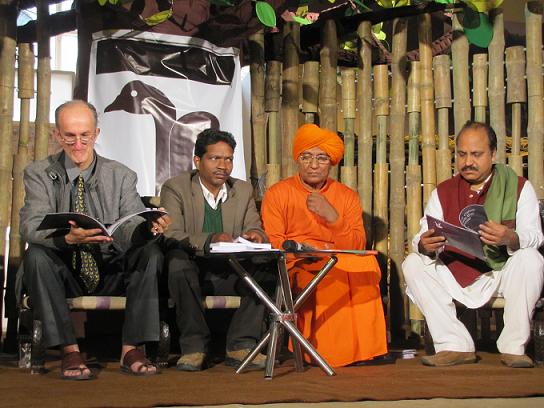
Felix PadelFelix Padel at the release of our first two books at the World Delhi Book Fair, February 2013

Felix Padel is an Anthropologist and the author of The Sacrifice of Human Being: British Rule & the Konds of Orissa (1995, 2000), Sacrificing People: Invasions of a Tribal Landscape (1995, 2010), Out of This Earth: East India Adivasis and the Aluminium Cartel (2010 with Samarendra Das) and Ecology, Economy: Quest for a Socially Informed Connection (2013 with Ajay Dandekar & Jeemol Unni ) and several articles emphasizing the wider significance of Indigenous issues.