Does language also have rhythm? from adivaani on Vimeo.
adivaani‘s language building through reading initiative in collaboration with the Tribal Cultural Heritage in India Foundation, Amsterdam, The Netherlands.

Does language also have rhythm? from adivaani on Vimeo.
adivaani‘s language building through reading initiative in collaboration with the Tribal Cultural Heritage in India Foundation, Amsterdam, The Netherlands.
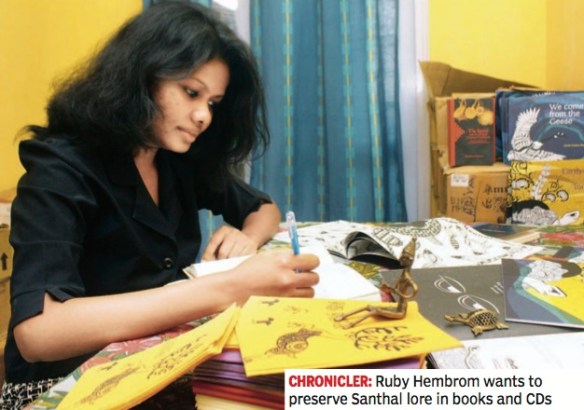
The passion to give something back to her community drives this young tribal woman to venture into an unknown terrain. Ruby Hembrom gave up a well paid job in the IT sector in Delhi five years ago and returned to Kolkata to preserve the dying Santhal language.

Ruby Hembrom had already worked for big names like IBM when she quit the IT-BPO sector. She had eight years in Training, Learning and Development, and she went straight to the villages of Jharkhand. But now, she is known for her publishing concern for tribal literature, Adivaani, which she has put up with her friends, Joy, Boski and Luis. Ruby speaks on Adivaani, life and more.

We are happy to announce that Rejina Marandi’s proposal tentatively titled: And I came to know…! is the one.
Congratulations Rejina!
Rejina is a Ph.D student at Pondicherry University, Department of Philiosphy. She is a Santal from Gosaingaon, Kokrajhar District, Assam.
Rejina proposes a novel of an Adivasi girls’ journey of witnessing, understanding, and rediscovering being Adivasi in the wake of the communal riots of 1996 in Assam and up until now.
The work of putting the book together starts now. The book will be released on International Day for the World’s Indigenous Peoples, August 9th, 2014 at Rejina’s hometown.
We thank everyone who participated and sent in entries and everyone who has supported this venture.
Why does adivaani do books?
Books keep history, heritage and identity alive; books reinvent, reinterpret and make relevant voices, thoughts, ideas and dreams. In the words, language, imagery and pages that books are made of are the threads of ourselves that each one of us contributes to build the Tapestry of traditions for our children.
This bit of yarn from adivaani and the Tribal Cultural Heritage in India Foundation is to help strengthen skills of communication in English a principal link language today.
Most Adivasi children with the opportunity at education are learning English at some level and in some form or the other. But there’s still a gap between them and other children in India.
We’d like our two illustrated books on the Santal Creation stories series to be the instrument to achieve this mastery of English and on another level accomplish something more critical– re-initiating the children to these wonderful stories of Adivasi origin–stories families or communities may have forgotten themselves or may not have had the time to re-tell.
Supplementing the books are two special simple animations to help the children practise English grammar and pronunciation.
The partnership with the Tribal Cultural Heritage in India Foundation has enabled us to circulate copies of the books and animations for free to schools, hostels, libraries, NGO’s and other agencies preserving and promoting Adivasi cultural heritage in Jharkhand, West Bengal, Orissa, Bihar and Assam.
But we now need you to add to the yarn. To facilitate the actualisation of the ‘language building through reading’ exercise we’re conducting a workshop on the 30th of November, 2013 and the 1st of December 2013 at Johar, HRD Centre, Dumka.
We need Adivasis to come forward to assist us with spreading the ethos of the project.
We can only accommodate 10 people at the workshop from where adivaani will host one of you to travel with the project to the centres identified to disseminate the learning.
The 2 day workshop on Language, Publishing, Books and Communication skills is sponsored, so if you’re willing to attend and commit to seeing the project through, just send in your names and contact information to info@adivaani.org by the 20th of November, 2013 and we’ll take care of the rest.
Looking forward to seeing you there!
***
Tapestry of traditions for our children:
A language building through reading initiative in collaboration with the Tribal Cultural Heritage in India Foundation, Amsterdam, The Netherlands.
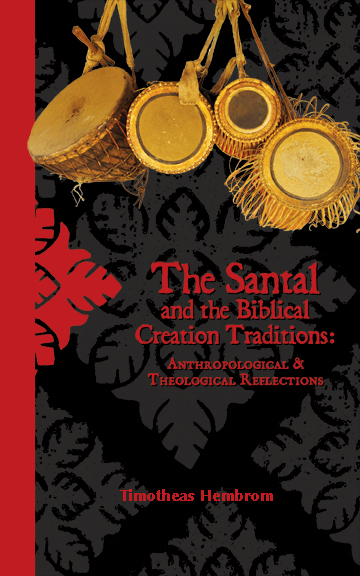
The Santal and the Biblical Creation Traditions: Anthropological & Theological Reflections
Language: English
Pages: 304
Rs. 200
In this book Timotheas Hembrom offers a brief and lucid introduction to the lifestyle and belief system of the Santals, showing that though they are a people of no scripture, they have as much knowledge about God the creator as the people of Scriptures. Hembrom also conducts an exegetical study and compares the Biblical and the Santal’s creation narratives. His findings and conclusions prove to be relevant for any reader interested in faith and the origin of religion.
Rev. Dr. Timotheas Hembrom has over 40 years of Theological teaching experience and is an ordained Priest of the Church of North India. He has taught at Chera Theological College, Cherrapunji, Bishop’s College, Kolkata, Gossner Theological College, Ranchi and The Santal Theological College, Benagaria.
A writer, editor, singer-musician, and songwriter, he wears many hats.
This book is a reflection of his love for words and language, and what he is at the core–a Santal, an Adivasi and a Theologian.
Just a heartfelt thank you…
On International Day for the World’s Indigenous Peoples, August 9th, 2013 adivaani instituted Adivasi PICKLE: a prize for Indigenous Ideology, Thought and Knowledge.
We thank everyone who sent in entries, everyone who promoted the event, those who sought out Adivasi brethren and friends and egged them on to participate.
We now wait on our jury to make their decision.
For those of you who would’ve missed who they are:
1) Dakxinkumar Bajrange: An award winning filmmaker, playwright, director and activist from the Chhara De-notified Tribes of Ahmedabad. He’s currently working at the Budhan Theatre as a director.
2) Sophia Pde: A Khasi academic from the Meghalaya. She is Assistant Professor at Central Library, University of Delhi. She has special research interest in Folk literature of North East India and is working on Khasi folklore.
3) Gladson Dungdung: An Adivasi human rights activist and writer. He is based in Jharkhand and is from the Kharia Tribe. He’s the author of Whose country is it anyway? and other books about Adivasis.
The next date to look out for is the 15th of November 2013 when we announce THE BOOK– the culmination of our first call to celebrate Adivasi being.
But don’t stop at that. This is just the beginning…
See you next year, at the next edition of Adivasi PICKLE!
For those of you who don’t know what we’re talking about–Adivasi PICKLE: a prize for Indigenous Ideology, Thought and Knowledge is a call to tap stories, narratives and accounts of Adivasi being. So if you’ve had ideas of a story brewing in your head and you’ve had words marinating, it’s time to serve them.
We’re taking bulk orders for them until the 30th of September 2013.
To participate:
1) Send in a proposal with a working title for a book in English within 5000 words, by the 30th of September 2013 at pickle@adivaani.org
2) Attach proof of your being Adivasi/Scheduled Tribe.
3) Fill in the cover form and send it along with the above two.
For further details view the information on the following links:
We’ve been receiving enquiries from people who are intimidated by the requirements of the participation for the prize. It appears that we are requesting for the new masterpiece or the most innovative way to view ourselves and our ways of life–we are. But that’s not all.
We know who we are. It continues to be a long struggle, living in the margins, getting accustomed to unfamiliar ways, cultures, languages, in a world where we aren’t really welcome. English might not be the language you are most comfortable with but we want everybody around (the world) to know us. So come as you are–we’re here to help your narrative take shape.
There is no small idea, no small dream, no insignificant voice and no trivial story!
Share your bit of yarn to complete the tapestry of Adivasi writing by partaking of some Adivasi PICKLE: a prize for Indigenous Ideology, Thought and Knowledge.
Be the story, the narrative, the legend, the chronicle!
3 steps and you are part of this beautiful loom.
1) Send in a proposal with a working title for a book in English within 5000 words, by the 30th of September 2013 at pickle@adivaani.org
2) Attach proof of your being Adivasi/Scheduled Tribe.
3) Fill in the cover form and send it along with the above two.
For further details view the information on the following links:
What is Adivasi PICKLE?
Application Details
https://adivaani.org/wp-content/uploads/2013/08/picklepickle.pdf
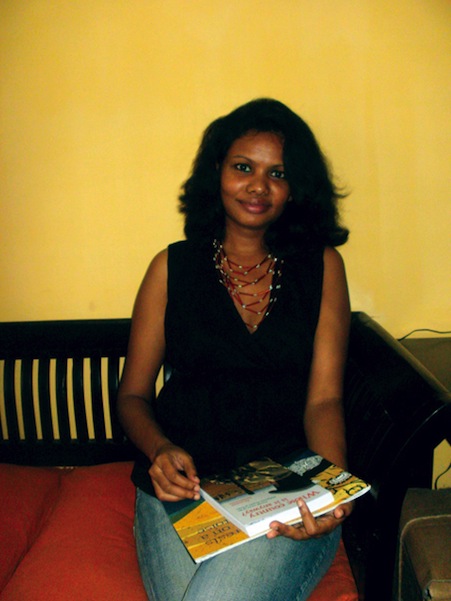
On August 8 this year, the eve of International Day of the World’s Indigenous Peoples, Ruby Hembrom decided to institute Adivasi Pickle, a “prize for indigenous ideology, thought and knowledge”. In the announcement, she called on Adivasis to share unpublished stories of their lives, struggles and triumphs. From the submissions, a jury will select “the most relevant entry”. This will be published in August, 2014, by Adivaani, a publishing house “by and for” Adivasis, started last year by Ruby.

Pickle is the perfect accompaniment to spice up any spread and the one key element common to every Indian kitchen and palate.
How about some Adivasi pickle? A pickle made of indigenous ways and thinking—the perfect accompaniment to our present—with ingredients that help us understand how our ancestral ways have preserved and sustained the earth, until newer ways dismissed them as primitive and we became a resource to be extracted, exploited and ignored. Ingredients that help refurbish traditions and knowledge webs, and ensure our future.
adivaani is therefore calling Adivasis to share more about ourselves. We’ve instituted a small prize of a book, out of love, on the International Day for the World’s Indigenous Peoples, August 9th, 2013. We’re short on what we can give, but we’re long on good wishes, hope and solidarity: you write, we publish. That’s the deal!
We believe the time for us to do things our own way is now. We want this event to be a celebration of a communion of by and for Adivasis—right from our sisters and brothers sharing and chronicling their personal narratives, to the publisher, not forgetting the jury formed of Adivasi intellectuals, scholars and artisans.
Join us, spread the word and…
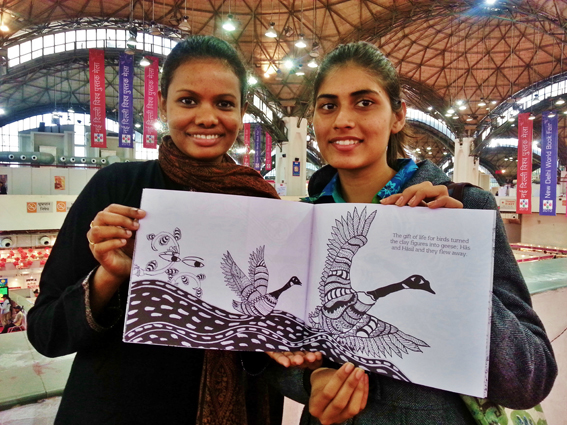
Ruby Hembrom left her well-paid job at a multi-national company, and now spends most of her time working on projects to take tribal folklore to the masses. She has set up her own publication firm, Adivaani, to promote the history of Adivasi struggles.
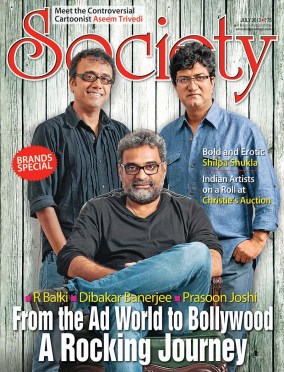
Kakoli Poddar, journalist with Magna Publishing, chose to feature adivaani in this month’s issue of Society:
Ruby says they want to create a database of adivasi writing of, for and by the adivasis. “We wish to document the oral forms of their storytelling and folklore. We also aim to narrate our stories of struggles, exploitation and displacement, in our words.”
Go get a copy. Find us on page 98.
Earthcare Books
10 Middleton Street
Kolkata-700071
West Bengal
Phone: 33 22296551 / 22276190
Email: earthcarebooks@gmail.com
Website : www.earthcarebooks.com
Happy shopping! Happy reading!
As we all know, 30th June is celebrated as Hul Diwas at Bhognadih to commemorate the Santal Rebellion of 1855-57. This year adivaani presents a Santal Hul calendar, beginning the 30th June, 2013 to the 30th June, 2014 as a memento to remember the occasion and to uphold the spirit of freedom and dignity.
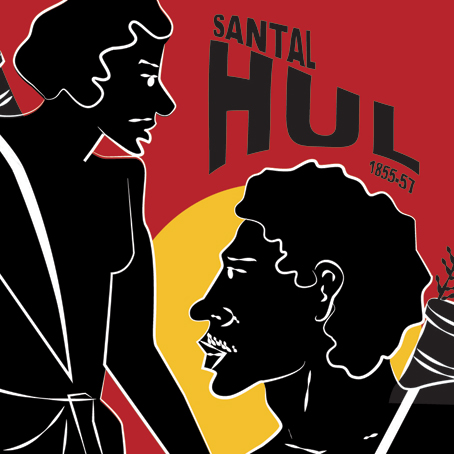
A sneak peek at the Hul Calendar 2013-14
adivaani is going to Bhognadih, all our titles will be available there.
Do visit our stall!
It’s raining goodwill for adivaani. This time it comes from CDC Printers, Kolkata.

After reading the feature on us in The Telegraph, Kolkata, CDC Printers got in touch with us saying they’d like to sponsor some of our work. We could hardly believe our ears.
Two meetings down the line we had it all figured out. They were impressed with our work and wanted to contribute to help us grow. They’re printing few of our productions for free and to encourage us to continue printing books without being burdened by budget constraints or compromising on quality, they’ve offered us a long-term arrangement that is the perfect solution for us.
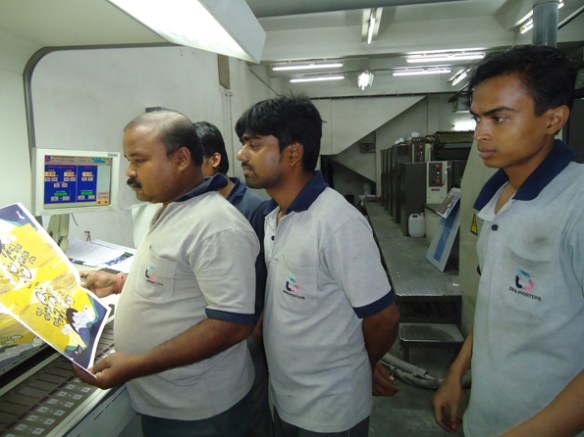
Earth rests on a Tortoise being printed
Our books now seem secure.
We’re now adding three products to the adivaani list:
1. Earth rests on a Tortoise, part two of the Santal Creation Stories. Once again, text by Ruby Hembrom and illustrations by Boski Jain.
2. The success of We come from the Geese; part one of the Santal Creation Stories in English prompted us to have it translated in Hindi. So grab your copy.
3. A Santal Hul calendar, beginning the 30th June, 2013 to the 30th June, 2014 as a memento to remember the Santal Rebellion (1855-57) and to uphold the spirit of freedom and dignity.

The Santal Hul Calendar
All we can say is a heartfelt thank you to Mr. Chittranjan Choudhury and the entire team at CDC Printers.
KOLKATA: When Ruby Hembrom quit her cushy job in the IT sector a couple of years ago, she didn’t think twice, thanks to the greater calling to unite with her roots. The result: the soft-spoken yet aggressive Santhali woman is all set to publish her second book that is part of a series on untold lore of the Santhals.
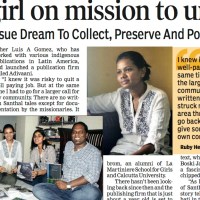
The second Santal Creation Story, Earth rests on a tortoise, will be available soon at a bookstore near you …
We’re southbound now! Get our books and bully Dileep Raj into serving you some piping hot filter coffee…
To create Adivaani, a publishing house launched by a group of three amateurs to lend a voice to the nation’s indigenous population, months of human planning and perseverance were required.

So, a new reviewer with an old name (Hutoom Pyancha) selects our children’s book to start up a blog… and we thank Shi… ooops, we thank that young little owl for words like these:
Through an exciting interplay between words and visuals a new world unfolds before the reader.
More at Turn over a new page…
Although we aren’t really the first or only adivasi publishing house in the country, we are thrilled to receive this kind attention from the media. Thank you, Saju Madhavankutty, from The Times of India – Chennai, for this feature:
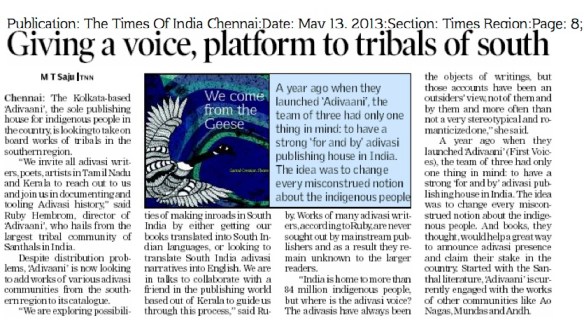

Why don’t we have an Adivasi voice?”, “Why don’t we have a ‘for and by’ Adivasi publishing house?”, “Where is the authentic Adivasi narrative?”

Culture cannot be lost. Toys are lost. Coins are lost. Culture is killed. Culture is disappeared. Culture is surrendered. The ones killing culture have names and addresses. Sometimes the assassins hide behind concepts like modernity. Sometimes the murderers speak in code, like development. But there is always an architect and a pilot – a person with a name and address – driving a culture to the brink.
This is a simple fact that is not learned from books but visible in every corner of human existence.
However, this, thankfully, is not a story of assassins.
Just as culture is killed, culture is protected, guarded, and nurtured. Like the assassins, the guardians have names and addresses. In this case, they have an Indiegogo campaign.
Over the past two months, I have read dispatches from adivaani, a fledgling press in Kolkata by indigenous peoples for indigenous peoples. For this Chicano, the story is familiar: the people’s history written by the “other,” the suspicious outsider with the resources to craft narratives that highlight the scandalous and ignore the contributions. Narratives that justify the murder of a culture – murder of the people.
Over time, the people master the tools of the master.
After the manuscript is carefully written, edited, and prepared, the people are confronted with publishers whom politely reject a work based on a notion of “the market” that does not consider the people. Despite a mastery of poetry for millennia, press workers doubt the peoples’ ability to read.
After the ink dries and the pages bound, despite centuries of exclusion, the book sells. Maybe not in numbers great enough to warrant inclusion in the Times list of product exchange. Nonetheless, the people buy. The people read. We see and hear ourselves in a place where there were once caricatures and cartoons.
You know this story. Who are your people?
Raza, are you listening?
This is the story of all peoples fighting to carve out a niche for themselves; fighting for a niche in a world that systematically marginalized the people, offering little beyond menial tasks, hard labor, and poverty. It is not, as they would say, a fight for a place in a world changing around us. That is a narrative written by the “other” and forced onto the people.
There are other ways. There are choices. The “other” offers its pearls at the cost of cultural suicide. Whispered in the peoples’ ear, it is the cost for the dream.
Sound familiar?
There remain other ways.
This is the story of the people, the ones here before the arrival of the “other,” the ones forced from their home and taught it was never theirs.
Do you recognize this story?
This is the story of the child who cannot speak her mother’s native tongue; the boy denied his birthright of history.
Yet this not the only narrative; there always remain other ways.
A father writes his daughter, explaining his dream of a time machine that will forever protect and preserve the culture handed down to him from the people: “Our passion alone cannot drive this time machine, we need fuel, and we need the support of everyone. I am worried and often wonder how we will make it. Then I look at you and when you play and make me laugh, I feel alive again. You inspire me. It’s for you and adivasi children like you that the adivaani time machine wants to preserve this culture legacy.”
We need the support of everyone.
You inspire me.
— George B. Sánchez-Tello
IMPORTANT NOTE: There are only 6 more days to contribute with our Indiegogo campaign… come on, dig in your pockets and purses.

 adivaani